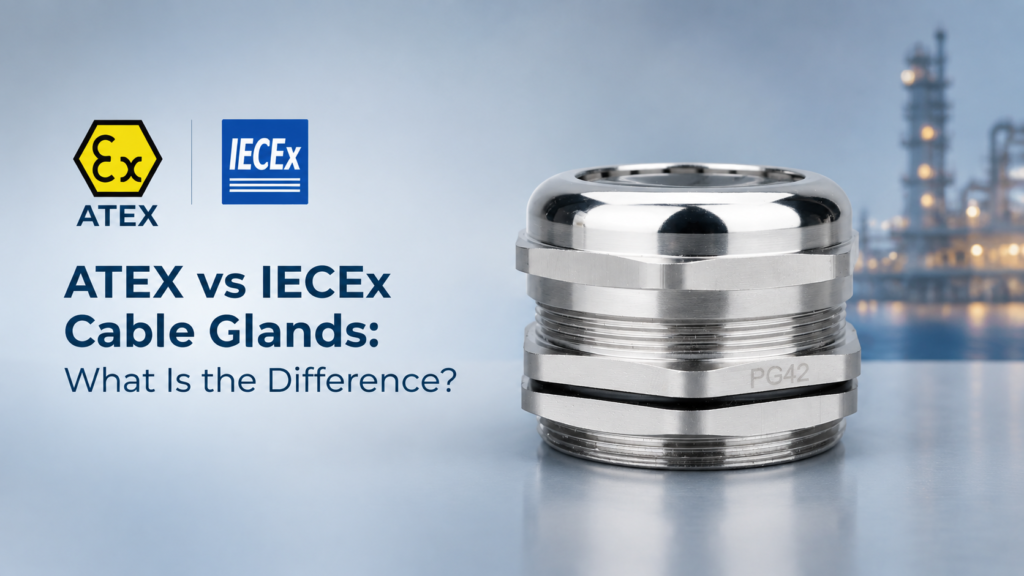
A cable gland marked “ATEX” and one marked “IECEx” can be the same part, machined on the same line, tested to the same IEC 60079 report. They are still not interchangeable for your project. The ATEX vs IECEx cable gland question arrives on almost every hazardous area enquiry, and what separates the two is not the engineering. It is the legal wrapper, the assessment route, and where the paperwork is accepted.
This guide is for the people who have to defend the choice: procurement, QA and project engineers comparing specifications. It covers what each scheme actually is, where the two diverge in ways a normal comparison table hides, how to read a certificate number, and how to verify a claim before you order rather than after the shipment lands.
The Difference in One Sentence
ATEX is European law. IECEx is a voluntary international certification scheme. Both point at the same science, but only one of them is something a company can be prosecuted for ignoring.
ATEX is the common name for EU Directive 2014/34/EU. Equipment placed on the EU or EEA market for use in potentially explosive atmospheres has to comply with it, and the manufacturer must apply the CE and Ex markings and hold a technical file. IECEx is operated by the IECEx Secretariat under the IEC conformity assessment system. No country is obliged to accept it, yet its certificates are recognised far beyond Europe.
أسبكت
ATEX
IECEx
Legal basis
EU Directive 2014/34/EU
IEC CA System (voluntary)
Legal status
Mandatory for the EU and EEA market
Voluntary; accepted by national regulators
Technical standards
EN 60079 series, harmonised from IEC
IEC 60079 series directly
Issued by
EU Notified Body (ExNB)
IECEx Certification Body (ExCB)
Certificate name
EU Type Examination Certificate
IECEx Certificate of Conformity
Factory audit
QAN (Quality Assurance Notification)
QAR (Quality Assessment Report)
Where it can be checked
Issuing body, listed in the EU NANDO register
One central IECEx online database
Because EN 60079 is a harmonised adoption of IEC 60079 with minimal national deviation, the gland behind both certificates is usually the same design. What differs is who tested it and who will accept the paper.
ATEX Is Two Directives, Not One
ATEX is not a single instrument. It is a pair with completely different obligations attached to them, and confusing the two is expensive.
Directive
Who must comply
What it obliges
2014/34/EU — equipment
Manufacturers, importers and distributors of Ex equipment
Certify the product before placing it on the market, apply CE and Ex markings, issue a declaration of conformity, keep the technical file for ten years
1999/92/EC — workplace
The employer operating the site
Classify every area into zones, produce an explosion protection document, and select equipment whose category matches each zone
A manufacturer has to satisfy the equipment directive before the gland reaches the market. The plant operator has to satisfy the workplace directive by zoning the area first and choosing equipment to suit it. A supplier saying “we are ATEX certified” has answered only the manufacturing half. If nobody has formally zoned the area, no certificate can tell you which gland belongs there. The two halves meet at the enclosure wall, where the gland’s protection concept has to agree with the concept protecting the box.
The Assessment Routes Are Not Equivalent
This is the part most comparison tables leave out, and it changes what you should ask a supplier for.
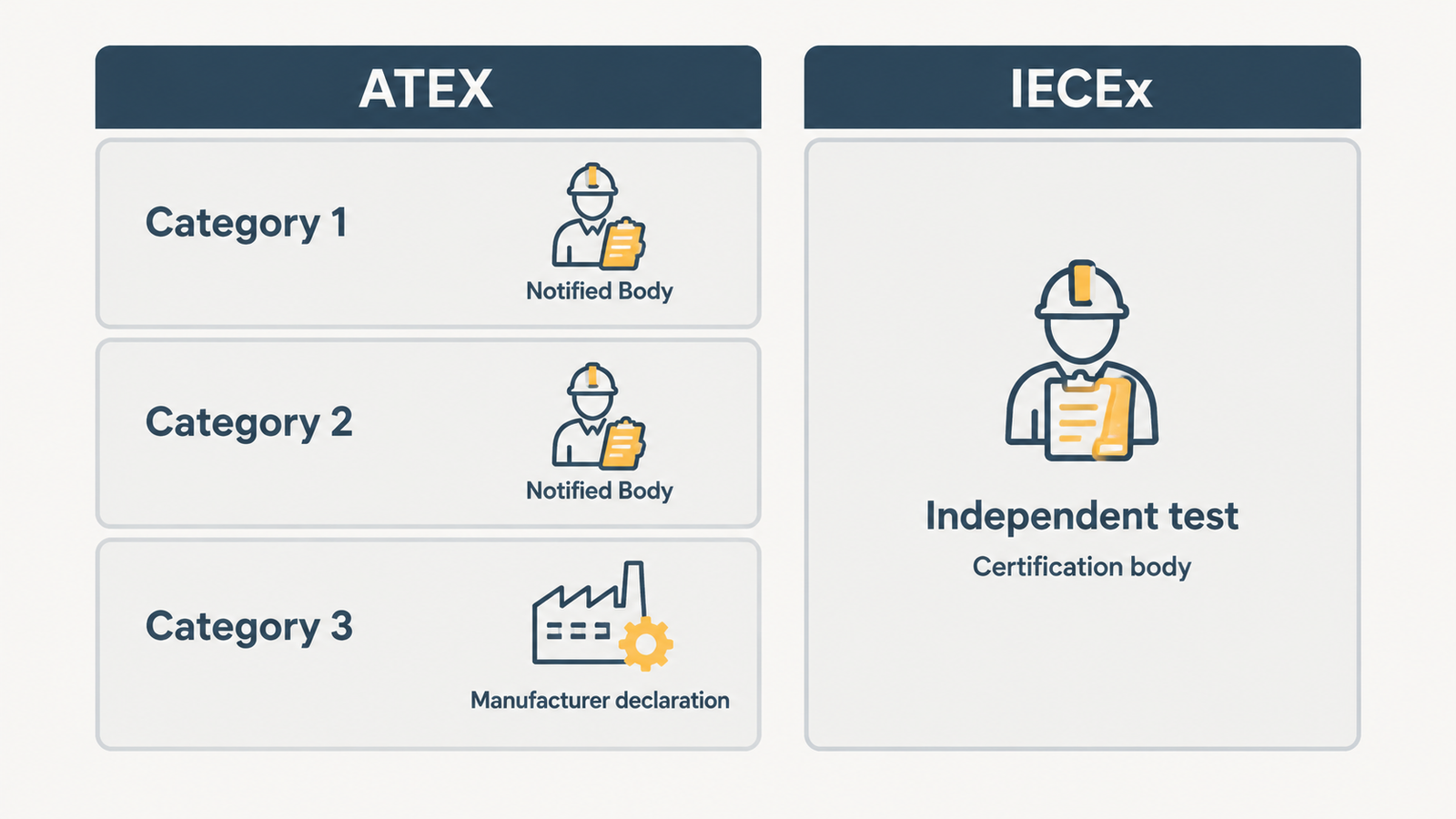
ATEX ties the rigour of assessment to the risk category of the equipment. Category 1 covers Zones 0 and 20, Category 2 covers Zones 1 and 21, and Category 3 covers Zones 2 and 22. The lower the risk, the less independent scrutiny the directive demands — and at Category 3 it demands none at all. The manufacturer applies internal production control, builds a technical file and self-declares conformity. No Notified Body is involved, and that is entirely legal.
IECEx does not make that concession. Every product carrying an IECEx certificate number has been independently tested by an ExCB, regardless of which zone it is destined for, and the resulting certificate is published centrally.
Destination
ATEX route
IECEx route
Zone 0 / 20 — Category 1
Notified Body type examination plus quality assurance
Independent test and certificate of conformity
Zone 1 / 21 — Category 2
Notified Body type examination
Independent test and certificate of conformity
Zone 2 / 22 — Category 3
Manufacturer self-declaration, no Notified Body
Independent test and certificate of conformity
ATEX ties the assessment route to the equipment category; IECEx requires independent testing for every zone.
So for a Zone 2 job, “ATEX certified” can mean a legally valid self-declaration with no independent test behind it. That is not a defect in the gland or the supplier; it is how the directive is written. But the two phrases are not evidence of the same thing. Where a specification or a third-party inspector wants independent test evidence at Zone 2, an IECEx certificate supplies it directly and verifies in seconds.
What the Certificate Number Tells You
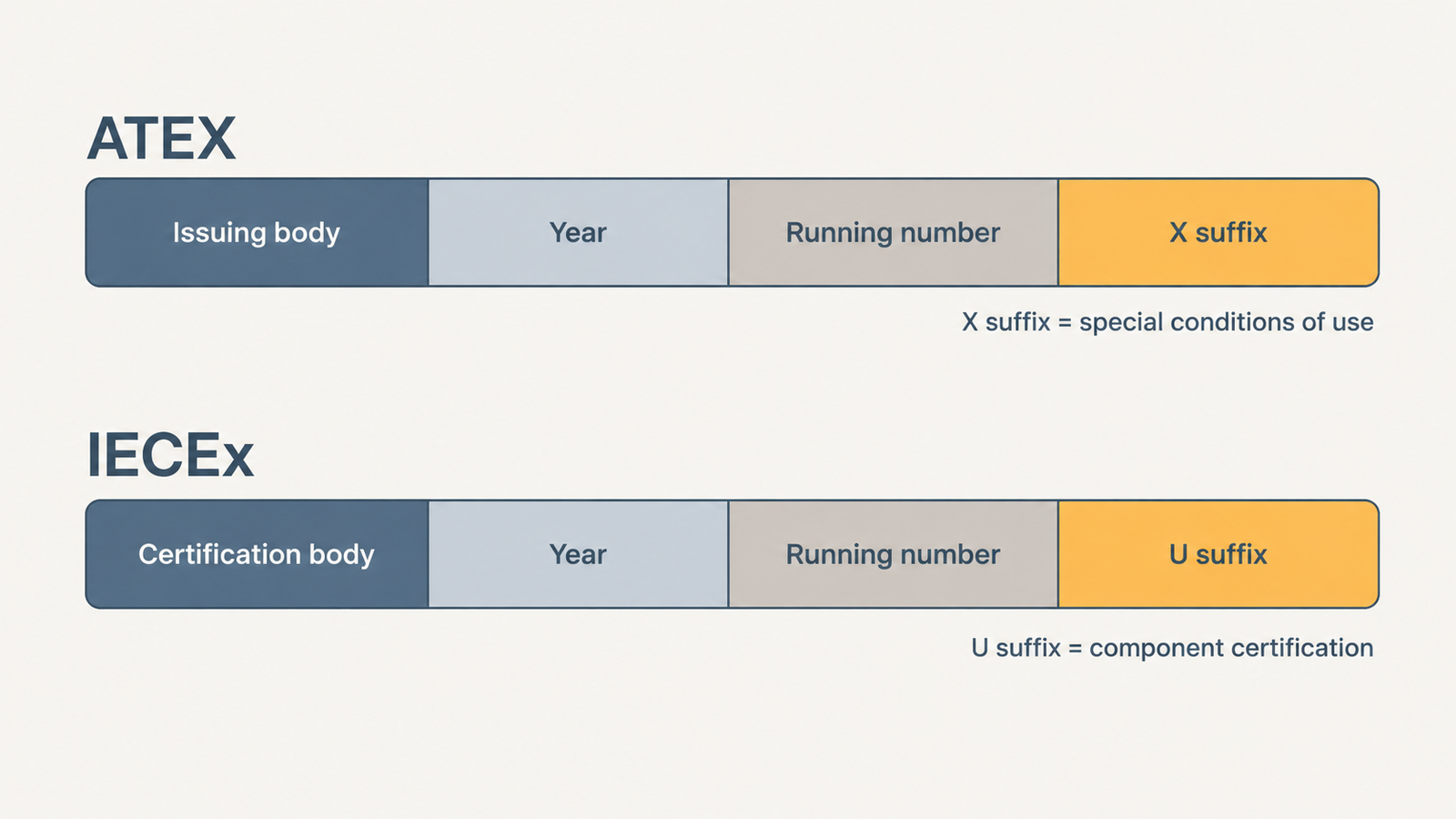
Both schemes print an identifier that decodes the same way, field by field.
Element
ATEX example
IECEx example
Full reference
Baseefa07ATEX0091X
IECEx BAS 17.0063X
Issuing body
Name of the Notified Body
ExCB letter code, e.g. BAS for SGS Baseefa
Year of issue
Two digits before “ATEX”
Two digits after the body code
Running number
After “ATEX”
After the year
Suffix X
Special conditions of use — read the schedule
Special conditions of use — read the schedule
Suffix U
Certified as an Ex component, not complete equipment
Certified as an Ex component, not complete equipment
The X suffix marks special conditions of use; the U suffix means the gland is certified as an Ex component.
A “U” on the number is normal for a cable gland rather than a warning sign. It means the certificate covers the gland as a component inside a system, so the enclosure it enters still has to be certified for the same concept, gas group and equipment protection level.
The schedule is where the real limits live. It lists the sizes, thread forms and cable ranges the certificate covers, and it does not stretch: a certificate issued for an M20 brass gland does not cover an M25 stainless one, even from the same range. Thread form is a common tripwire — a parallel metric entry and a tapered NPT entry are different entries, not different labels, as the guide to cable gland thread types explains.
One diagnostic detail follows from the same logic. Category 1 and 2 electrical equipment carries the four-digit Notified Body number beneath the CE mark, because a Notified Body assessed it. Category 3 equipment does not. No number means no independent body was involved.
Where Each Certificate Is Accepted
There is no conversion between the two schemes in either direction. An ATEX certificate does not become an IECEx certificate, and an IECEx certificate does not satisfy EU law. What does travel is the test evidence: an IECEx test report is a standardised and transferable document, which makes national approvals cheaper to obtain, though it is not itself an approval.
Market
What is normally required
European Union and EEA
ATEX to Directive 2014/34/EU — mandatory
Great Britain
UKCA and UKEX, closely aligned with ATEX; CE recognition has been extended
Middle East, Australia, New Zealand, Singapore, Brazil, South Africa
IECEx
India
IECEx widely accepted, with local approvals also applying
United States and Canada
Neither scheme — NEC and CEC class or zone rules, certified by UL, FM or CSA
China
Neither scheme — GB 3836 and CCC Ex
Material is a separate decision from scheme. The stainless steel cable gland range carries the offshore, marine and chemical entries where corrosion decides service life; the brass cable gland range covers general plant and control rooms at lower cost. Neither choice changes which certificate the site requires.
Do You Need Both?
For a multi-territory project, usually yes. A gland sold into the EU needs ATEX, and the same gland sold into the Gulf needs IECEx, so a single order shipping to several regions will normally carry both. Because both schemes point at the same IEC 60079 test programmes, the economical approach is to design and test once and take both certificates off that shared evidence.
Expect a specification from an EU-based EPC contractor to ask for both even when the site is outside Europe, because that contractor answers to EU product law for what it places on the market. Our CMP explosion proof gland range is the version to compare against when a dual-certified specification arrives. Ask for the certificate copies with the quotation, not with the shipping documents — that is the point at which you can still change the order without changing the schedule.
How to Verify a Certificate Before You Order
Check
Why it matters
Certificate number marked on the gland body
A datasheet claim with no marking on the product has nothing behind it
Exact model, size and thread form in the schedule
Certificates are product and size specific and do not extend across a range
Certificate status current, at the latest issue
Superseded issues and withdrawn certificates are common in older quotations
Gas group and equipment protection level match the zone
Certification outside the site atmosphere is void for that installation
Protection concept matches the enclosure
An increased safety gland on a flameproof box breaks the flameproof barrier
Ambient range covers the site conditions
A certified ambient band is a boundary, not a guideline
IECEx record found in the online database, or Notified Body valid in NANDO
This verifies the issuer rather than taking the claim on trust
Run the same test on the gland you expect to receive. A stainless steel entry such as the PG42 cable gland for hazardous areas should arrive with a certificate number matching a live record and a schedule naming that exact thread size.
What Neither Certificate Covers
Both schemes certify the product as manufactured. Neither certifies your installation, and the gaps between them are where field problems start.
The assembly is not certified. A certified enclosure fitted with an uncertified gland is not a certified installation. The certificate stops at the product boundary.
Your site is not zoned by a certificate. Zone classification is the operator’s duty under the workplace directive, and it comes before equipment selection, not after.
Certification does not transfer to a similar part. A different size, thread form or material is a different product for certification purposes.
Compliance is not corrosion performance. Neither scheme tells you how long a plated brass gland will last in a chloride atmosphere.
Neither certificate proves a specific unit was built to the certified drawing. That is what the quality assessment and batch traceability exist to cover.
الأسئلة الشائعة
Does an IECEx certificate make a cable gland legal in the European Union?
No. EU law requires conformity with Directive 2014/34/EU. IECEx is accepted by many regulators worldwide, but it is voluntary, and it does not discharge an EU legal obligation.
Can an ATEX certificate be converted into an IECEx certificate?
No, there is no conversion route in either direction. IECEx requires assessment by an IECEx Certification Body. Because both schemes use the same IEC 60079 test programmes, shared test evidence can reduce repeat testing, but it does not remove the assessment.
Are ATEX and IECEx technically the same?
Largely yes. The EN 60079 series harmonises IEC 60079 with minimal national deviations, so the design requirements on the gland are close to identical. The differences are the legal framework, the certificate format, the assessment route and where each is accepted.
Is a manufacturer’s declaration enough for a Zone 2 cable gland under ATEX?
For Category 3 equipment, yes. Internal production control with a technical file and a declaration of conformity is a legal route, with no Notified Body involvement. IECEx has no equivalent, which is why an IECEx certificate is stronger evidence of independent testing at Zone 2.
Does one certificate cover every size in a product range?
No. Certificates are issued for specific models, sizes, thread forms and cable ranges listed in the schedule. Always match the certificate against the exact part number being ordered.
Next Step
Send us the zone and gas group, the enclosure protection concept, the cable construction with its measured diameter, the entry thread, and the country the installation is going into. We will confirm which certificate set the project needs, supply the certificate copies and schedules with the quotation, and give you an FOB price for your quantity. For the wider picture, start from the cable gland hub or the full selection guide to cable gland types.
استكشف موصلات غدة الكابلات المتينة المقاومة للماء مع تصنيفات IP67 وIP68 من النايلون والنحاس الأصفر والفولاذ المقاوم للصدأ لحماية الكابلات وتخفيف الضغط بشكل آمن.
هل عانيت من قبل في اختيار غدة الكابل المناسبة؟ لا تقلق - لست وحدك! قد تكون غدة الكابلات صغيرة، ولكنها تلعب دوراً رئيسياً في ضمان سلامة واستقرار أنظمتك الكهربائية. سواءً كنت تعمل في مجال الأتمتة الصناعية أو البتروكيماويات أو الهندسة البحرية، فإن اختيار غدة الكابلات الخاطئة يمكن أن يؤدي إلى تسرب المياه أو قصر [...].
If you ever typed “are cable glands waterproof” into Google, you not alone. It one of those procurement-and-engineering questions that sounds simple, but it hides a bigger issue: “waterproof” is not a precise engineering specification. In real projects—outdoor telecom cabinets, marine sensors, washdown food lines, rooftop PV combiner boxes—what you really need is a cable […]
نحن نستخدم ملفات تعريف الارتباط لتحسين تجربة التصفح الخاصة بك، وعرض إعلانات أو محتوى مخصص، وتحليل حركة المرور لدينا. بالنقر على "قبول الكل"، فإنك توافق على استخدامنا لملفات تعريف الارتباط.