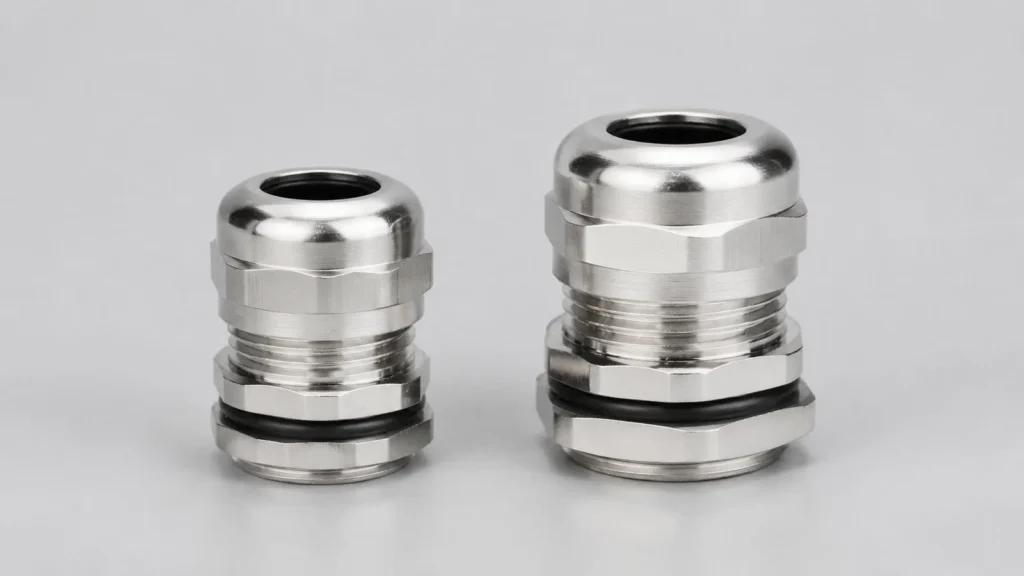
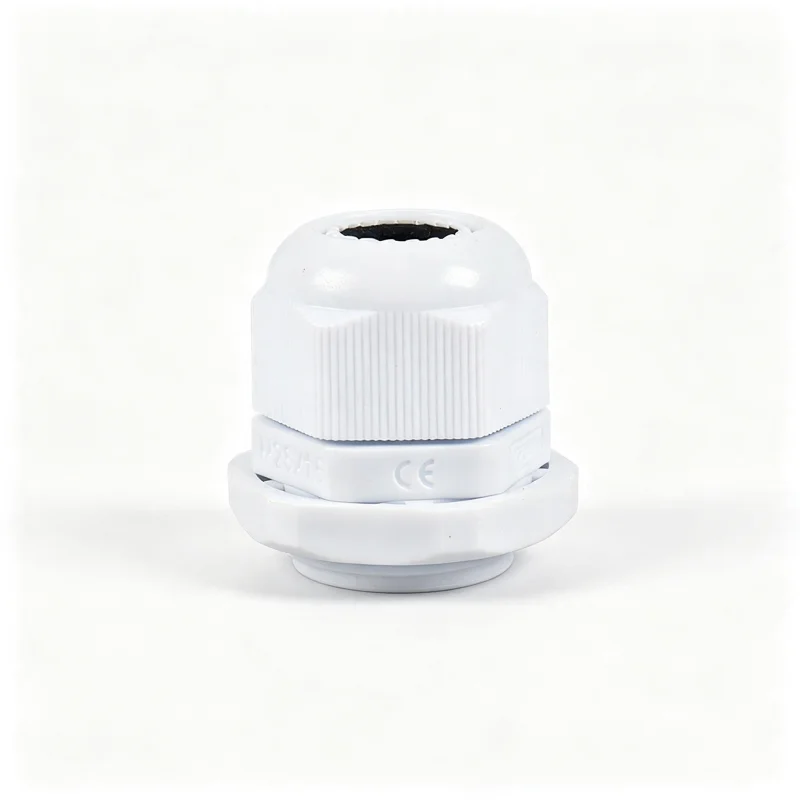
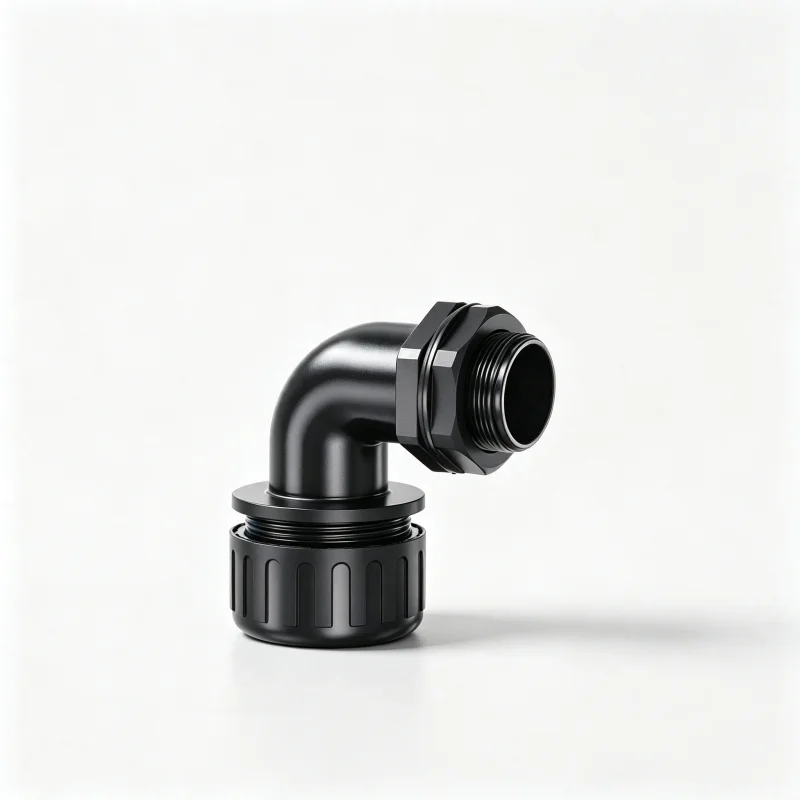
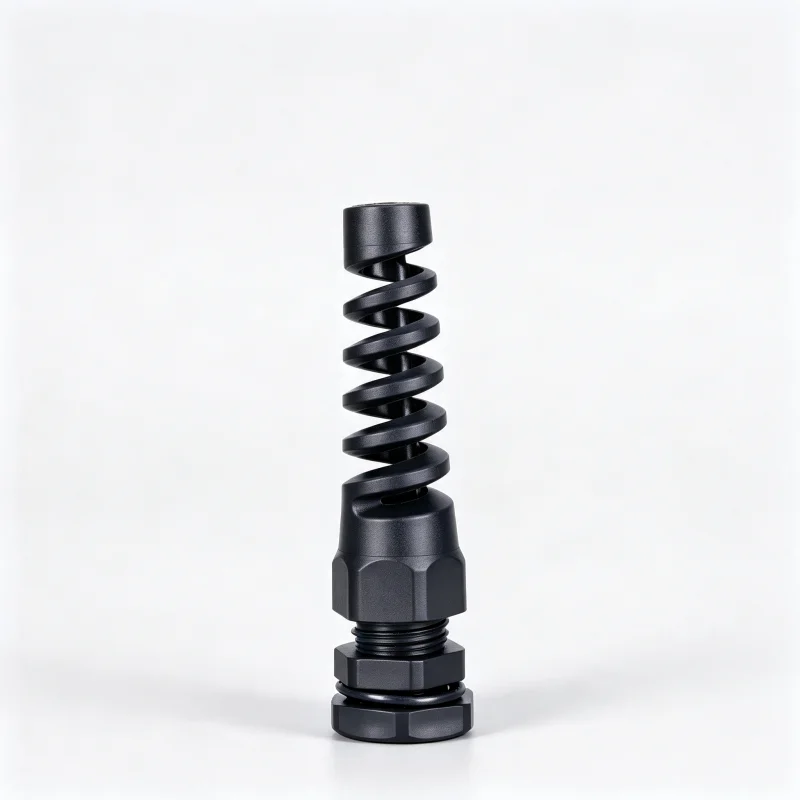
A spanner size is not a data point on a datasheet. It is the interface between the gland and the only thing standing between a correct seal and a ruined one: the tool in the fitter’s hand. Two installations with the same gland, the same torque and the same cable can end differently because one was done with a six-point socket and the other with an adjustable wrench that was already slack in the jaw.
This page is about the tooling side of that interface — which tool type survives which job, how much room the tool needs, what happens above the size where adjustable wrenches stop, and how to kit out a workshop that stocks several families. The size values themselves are on the جدول مقاسات مفاتيح الربط.
Why the Tool Decides the Seal
Three things have to be true at the end of an installation: the insert is compressed enough to seal, the body is seated on its gasket, and neither the hex nor the plating is damaged. The tool controls all three. Too little leverage and the insert is under-compressed; too much and the dome nut splits or the insert takes a permanent set, which is the same failure mode described on the تخفيف الضغط page from the cable side.
Damage is the part that gets ignored because it is invisible at handover. A rounded hex or a gouged plating passes the pressure test on the day and fails two years later, when corrosion starts in the tool mark and the joint is seized the next time someone needs to open it.
Spanner Types and Where Each One Fails
There is no universal tool, because the constraint changes with the job. A gland on a bench and the same gland between two others on a gland plate need different tools even though the hex is identical.
Tool
Works when
Fails when
Open-end spanner, correct size
There is a swing arc and the cable is already fitted
Access is tight; grips two flats only, so it spreads under load
Ring spanner
The gland is not yet on the cable
The cable is terminated — a ring cannot pass over it
Flare nut (split ring) spanner
Cable in place, high torque needed
Hex is shallow, or the slot fouls a nearby wall
6-point socket, deep
Full hex engagement, torque control, production work
Depth is short and the socket bottoms on the dome nut
12-point socket
Awkward swing angles
Hex is already tight or slightly undersize — it rounds corners
Adjustable wrench
One-off, slack jaw is tolerable, hex is steel
Brass or nylon hex; the jaw spreads and takes the corners off
Strap or chain wrench
Sizes past any fixed spanner
Small hexes, and it marks any soft surface
Buy tools by across-flats, not by thread: the same value appears on several thread sizes, on both the body and the locknut.
Reading the Spanner Column
Two entries in one cell means one gland needs two tools, not that either will do. The pairs are body hex and locknut hex, they are frequently different sizes, and a gland installed with only one of them is being driven through its gasket rather than seated on it. The جدول مقاسات الخيوط is the companion page, because the thread decides the hole long before the hex decides the tool.
The tooling consequence is the one that catches people out: the second tool has to reach the far side of the panel, and on a thin enclosure with a folded return or a DIN rail behind it, that is where access fails first. If only one side is reachable, the installation method changes — not the gland. See the locknut page for what the second nut is actually doing.
The Access Envelope
The hex is the smallest thing in the assembly. Every tool that grips it is bigger, and the tool has to travel, so the space a gland needs on a plate is set by the tool and not by the thread. This is why a layout that looks generous on a drawing still cannot be assembled.
Constraint
What to measure before ordering
What changes if it fails
Centre distance between glands
Outside diameter of the socket you intend to use
Socket cannot fit; use a spanner, or space the entries
Swing arc
Angle available before the handle hits the next gland or the panel edge
Open-end spanner unusable; switch to ratchet or socket
Depth above the plate
Dome nut height plus socket depth
Socket bottoms on the dome and never reaches the hex
Distance to a folded edge or flange
Handle length at the angle you can actually hold
Straight tool cannot be used; use a crowsfoot or a stubby
Spacing that looks fine on a drawing can still be unbuildable once the socket body and the handle swing are taken into account.
The practical rule is to lay out the entry positions from the tool you own, not from the thread diameter plus a margin. On a gland plate with a dozen entries the binding constraint is almost always the socket body, and the second constraint is the handle; the جدول أحجام الثقوب gives the drilling dimension, which is the smallest of the three numbers involved.
Large Sizes Beyond the Adjustable Wrench
The catalogue does not stop where the common tools do. Above about 60 mm across flats the choices narrow quickly: a large adjustable wrench is at the end of its jaw travel, and the leverage needed to turn it makes the slack jaw dangerous rather than merely annoying.
This site’s largest common sizes make the point. PG63 is 78 mm, brass M63 is 64 on the body and 68 on the locknut, and the nylon range continues past them — M63 at 74, M72 and M75 at 88, M88 at 98, M100 at 110 and M114 at 122. A fixed open-end wrench is available up to about 80 mm; beyond that the realistic options are a strap wrench, a purpose-made socket, or a custom tool. A 122 mm nylon hex in a corner is a design error, not a tooling problem.
A Kit Sized by Across-Flats, Not by Thread
Buying tools by thread size produces a drawer full of duplicates, because the same across-flats value serves several threads. Sorting the range by A/F instead shows how few tools a mixed stock actually needs, and where the awkward gaps sit.
Across flats (mm)
Served on this site by
Tool note
14
PG7 brass and stainless
The smallest in the metric and PG ranges
17 / 18
M14, M16, PG9
Small open-end or socket
20 / 21 / 22
M18, M20, PG11, PG13.5
22 is the busiest single value in the range
24 / 27
M22, M24, M25, PG16, PG19
Standard double open-end pairing; two sizes in one tool
30 / 32
M28, M30, PG21
Standard pairing again
35 / 40 / 45
M32, M33, M36, M37, M40, M42, PG25, PG29
No single tool covers all three; expect a gap
50 / 52 / 57
M48, M50, PG36, PG42
M50 is the one brass size where the locknut hex is smaller than the body
64 / 68 / 78
M63, PG48, PG63
Fixed spanner territory; adjustable is at its limit
74 up to 122
Nylon M63 to M114
Strap wrench, socket or custom tool
Two conclusions follow. First, a workshop can cover the whole brass and stainless metric and PG range with roughly a dozen tools, most of them standard double open-end sizes — the full per-size list, including the values for a standard brass metric body, sits on the chart page. Second, the small hexes and the large ones need different tools, so a single “big adjustable” is the worst possible purchase: useless on the small end and unsafe on the large one.
Nylon and Brass Need Different Hands
The same across-flats value does not mean the same tool technique, because the materials fail differently. Brass and stainless want full six-point engagement and a controlled load, because a rounded corner on a plated hex is where corrosion begins — the same mechanism that makes a nickel-plated body fail at a scratch rather than everywhere at once.
Nylon wants less load and no teeth. A pipe wrench or a pair of grips leaves stress raisers on a moulded hex, and a stress raiser on polyamide becomes a crack when the part is shocked or when sunlight and heat have already taken the toughness out of it. A socket with modest leverage is the right answer, and an impact driver is the wrong one at any size.
What the Wrong Tool Leaves Behind
Tool damage is usually attributed to the gland, the cable or the weather. The pattern is consistent enough to read backwards from the failure to the tool that caused it.
What you find
Tool behind it
Consequence
Rounded hex corners on brass
Adjustable wrench with a slack jaw, or open-end on a tight hex
Joint cannot be re-tightened or opened; plating broken
Tooth marks on a nylon hex
Pipe wrench, grips or slip-joint pliers
Stress raisers; crack initiates at the mark
Split dome nut, intact thread
Over-torque, often with a cheater bar
Seal lost; the failure looks like a material fault
Insert compressed flat into the body
Impact driver or power tool
No elastic recovery left; leak appears within months
Gasket abraded or twisted
Spanner on the body while the locknut was already tight
Seal path damaged before the joint was ever loaded
Torque Tools and Verification
A torque value is only as good as the tool that applies it. An open-end spanner cannot be used to deliver a controlled torque in any repeatable way, a socket on a torque wrench can, and a crowsfoot adds effective length and therefore changes the number the wrench must be set to. That correction is small in absolute terms and large in proportion on a gland, which is why production lines that care about this use a socket and a fixture rather than a spanner and a feel.
We do not publish a single tightening torque, because the correct value depends on the size, the insert compound and whether the joint is metal-to-metal or seating on a gasket. What can be specified is the outcome: the insert compressed evenly, the body seated, no visible mark on the hex, and the joint still holding after a thermal cycle. The دليل عزم الدوران covers how to establish that value for a given size, and the loosening page covers what happens when the tool was adequate and the joint still came loose.
الأسئلة الشائعة
Do I need two spanners for one gland?
Usually yes. Where the spanner column shows a pair, the body hex and the locknut hex differ, and holding one while tightening the other is what seats the gland instead of spinning it. A single tool drives the assembly through its gasket.
What socket size fits a cable gland hex?
The socket is specified by across-flats, so it is the same number as the spanner — a 22 mm hex takes a 22 mm socket. Use a deep socket: the dome nut stands above the hex and a standard socket will bottom out on it before engaging.
Can I use a torque wrench on a cable gland?
Yes, with a socket and on a size where the socket clears the surrounding entries. Do not use a crowsfoot without correcting for the added effective length, and do not expect a repeatable result from an open-end spanner.
What tool is used for PG63 and larger?
PG63 is 78 mm across flats, so a fixed open-end wrench of 75 to 80 mm is the practical tool. Past about 80 mm, and for the large nylon sizes up to 122 mm, a strap wrench or a purpose-made socket is the realistic option.
How much clearance is needed between adjacent glands?
Set it from the outside diameter of the tool, not the hex. Measure the socket you intend to use, add the space the handle needs to swing, and lay the entries out from that number — then check the deepest one against the socket’s depth.
اختر وصلات الكابلات المقسمة بشكل صحيح من خلال مراعاة قطر الكابل، والمسافة الفاصلة بين الموصلات، وطريقة التثبيت، ودرجة الحماية IP، والمواد، والبيئة المحيطة، والاعتمادات.
يمنحك M22 نطاق الكابل الخاص بـ M25 مع طول الخيط الخاص بـ M20. سبب وجود هذا الحجم، والأبعاد الخمسة الكامنة وراءه، والفرق البالغ 0.5 مم الذي يجعل PG16 فخًّا.
عندما يتعلق الأمر بضمان سلامة ومتانة وكفاءة التركيبات الكهربائية، تلعب غدة الكابلات المتواضعة دوراً حاسماً. سواءً كنت تعمل في مجال الأتمتة الصناعية أو النفط والغاز أو الاتصالات أو الطاقة المتجددة، فإن اختيار غدة الكابلات المناسبة يمكن أن يحدث فرقًا كبيرًا في أداء أنظمتك وطول عمرها. في هذه المقالة، سوف نستكشف [...].
نحن نستخدم ملفات تعريف الارتباط لتحسين تجربة التصفح الخاصة بك، وعرض إعلانات أو محتوى مخصص، وتحليل حركة المرور لدينا. بالنقر على "قبول الكل"، فإنك توافق على استخدامنا لملفات تعريف الارتباط.