What an EMC cable gland does that a standard gland cannot
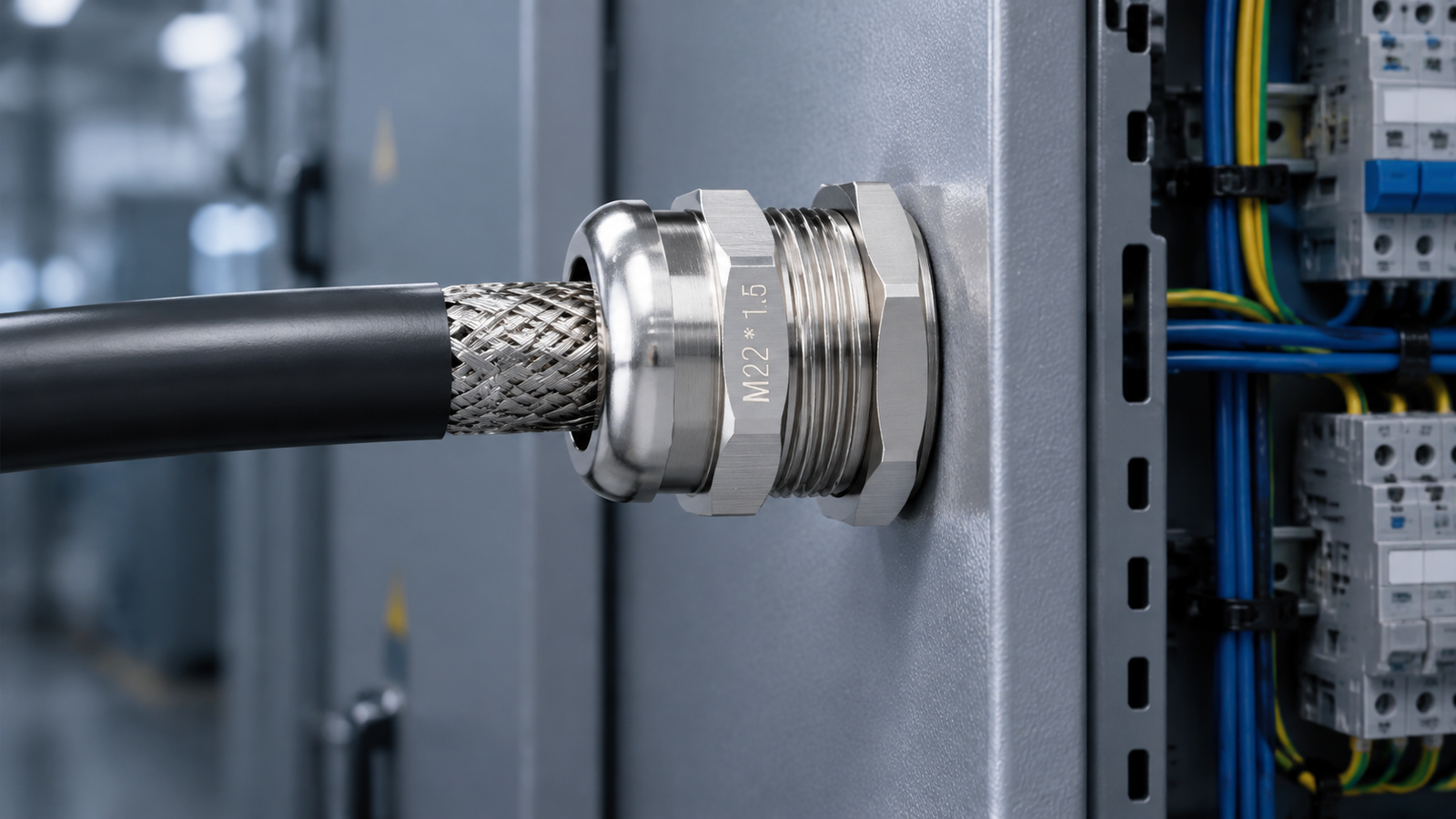
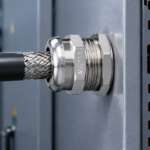
A standard cable gland does two jobs: it seals the entry and it grips the sheath. It does nothing for the shield. An EMC cable gland adds a third job — a low-impedance path from the cable braid or foil to the enclosure wall, so interference picked up on the shield is drained to earth instead of being radiated inside the cabinet.
That third job is the whole point, and it is also where most specifications go wrong. A nickel-plated brass gland is conductive, but conductivity alone is not shielding. If the braid is connected through a pigtail, or touched at one point by a screw, the joint behaves as an inductor at high frequency and the shielding effectiveness collapses exactly in the band that matters. The 360° shield termination method is what separates an EMC gland from a metal gland.
How the 360° contact works
Three features do the work, and each one has a failure mode worth knowing:
- Contact spring. A copper alloy spring ring sits inside the body with fingers that splay outward as the cap is tightened. Pressure is maintained by the spring, not by the installer’s wrist, so the contact survives vibration.
- Open fingers. With the cap loose the fingers stay open, so the cable can still be rotated and positioned without dragging the braid across the contact edges. This is where cheap copies fail: closed fingers scrape the shield during adjustment.
- Bonding path. Spring, body and enclosure wall form the conductive chain. The thread is a joint in that chain, so a powder-coated enclosure needs the coating removed at the entry face, or an earth tag fitted under the body.
Key features
- 360° shield contact around the full circumference, with no pigtail and no separate bonding kit
- Shield folds back over the clamping insert and is trapped by the spring, so assembly stays a one-person job
- Seal and shield contact are independent: the sheath seal is set by the cap, the shield contact by the spring
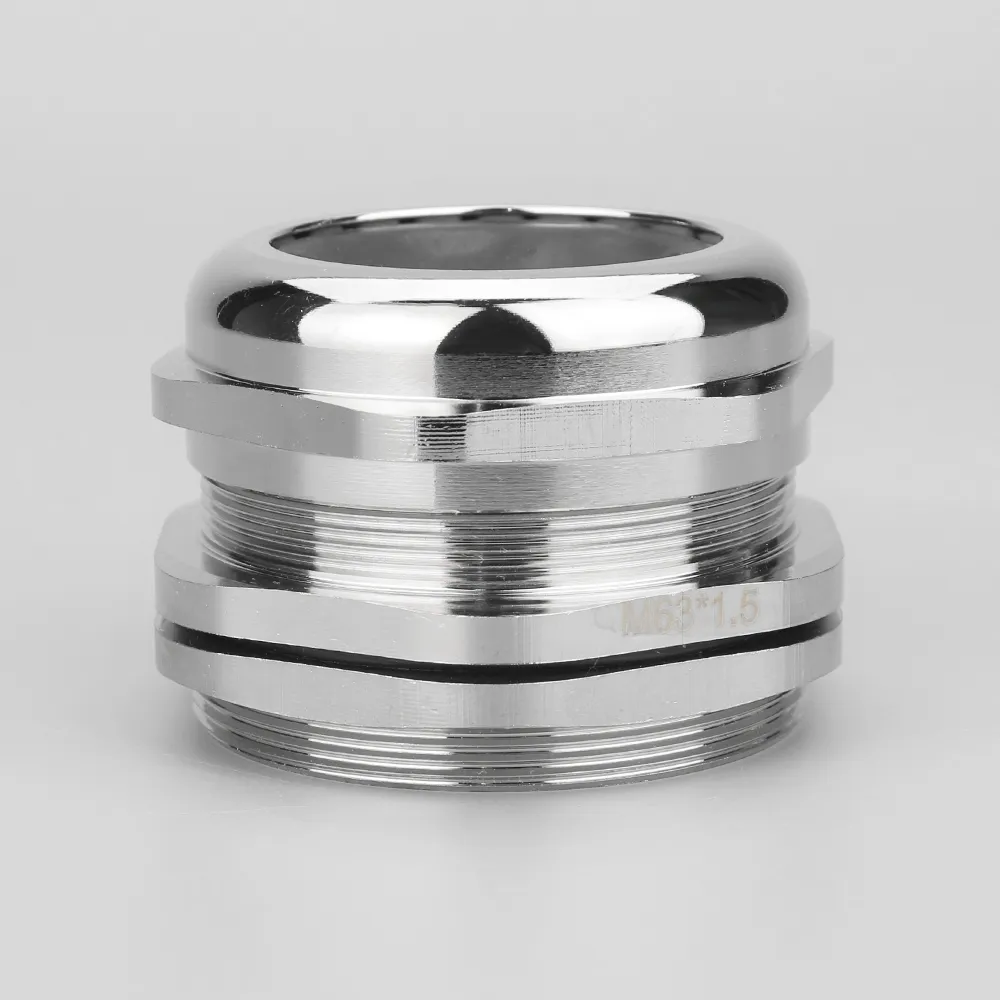
- Nickel-plated brass body; stainless steel 304 or 316L available for coastal and chemical service
- Metric M14–M63 and PG7–PG63 threads share the mounting holes of the standard series
- Available with locknut, earth tag, sealing washer and shroud as a single order line
Technical parameters
| الممتلكات | Specification |
|---|---|
| Body and nut | Nickel-plated brass (stainless steel 304 / 316L on request) |
| Contact spring | Copper alloy, 360° circumferential contact |
| Clamping insert | Polyamide |
| ختم | NBR as standard; EPDM or silicone on request |
| O-ring | إن بي آر |
| Protection degree | IP68, graded 1.5 m / 30 min, 2 m / 24 h (standard), 5 m / 72 h, 10 m / 168 h |
| Working temperature | −40 °C to +120 °C (brass); −40 °C to +200 °C (stainless steel) |
| Threads | Metric EN 60423 and PG DIN 40430; NPT and G(PF) on request |
| المعايير | EN 50262, IEC 62444, IEC 60529; EMC performance assessed against IEC 61000-6-2 and CISPR 11 |
| Options | Locknut, earth tag, sealing washer, shroud, stainless body |
Metric series: M14 to M63
| الطراز | Thread AG | Cable range (mm) | عمق اللولب (مم) | Mounting hole (mm) | Thread length GL (mm) | حجم مفتاح الربط (مم) |
|---|---|---|---|---|---|---|
| M14-EMC | M14×1.5 | 4–8 | 14 | 14-14.2 | 7 | 17 |
| M16-EMC | M16×1.5 | 4–8 | 16 | 16-16.2 | 8 | 18 |
| M18-EMC | M18×1.5 | 5–10 | 18 | 18-18.2 | 8 | 20 |
| M20-EMC | M20×1.5 | 6–12 | 20 | 20-20.2 | 8 | 22 |
| M22-EMC | M22×1.5 | 10–14 | 22 | 22-22.2 | 8 | 24 |
| M24-EMC | M24×1.5 | 10–14 | 24 | 24-24.2 | 9 | 24/27 |
| M25-EMC | M25×1.5 | 10–14 | 25 | 25-25.2 | 9 | 24/27 |
| M28-EMC | M28×1.5 | 13–18 | 28 | 28-28.2 | 9 | 30 |
| M30-EMC | M30×1.5 | 13–18 | 30 | 30-30.2 | 9 | 30/32 |
| M32-EMC | M32×1.5 | 15–22 | 32 | 32-32.2 | 10 | 35 |
| M33-EMC | M33×1.5 | 15–22 | 33 | 33-33.2 | 10 | 35 |
| M36-EMC | M36×1.5 | 18–25 | 36 | 36-36.2 | 10 | 40 |
| M37-EMC | M37×1.5 | 18–25 | 37 | 37-37.2 | 10 | 40 |
| M40-EMC | M40×1.5 | 18–25 | 40 | 40-40.2 | 11 | 40/45 |
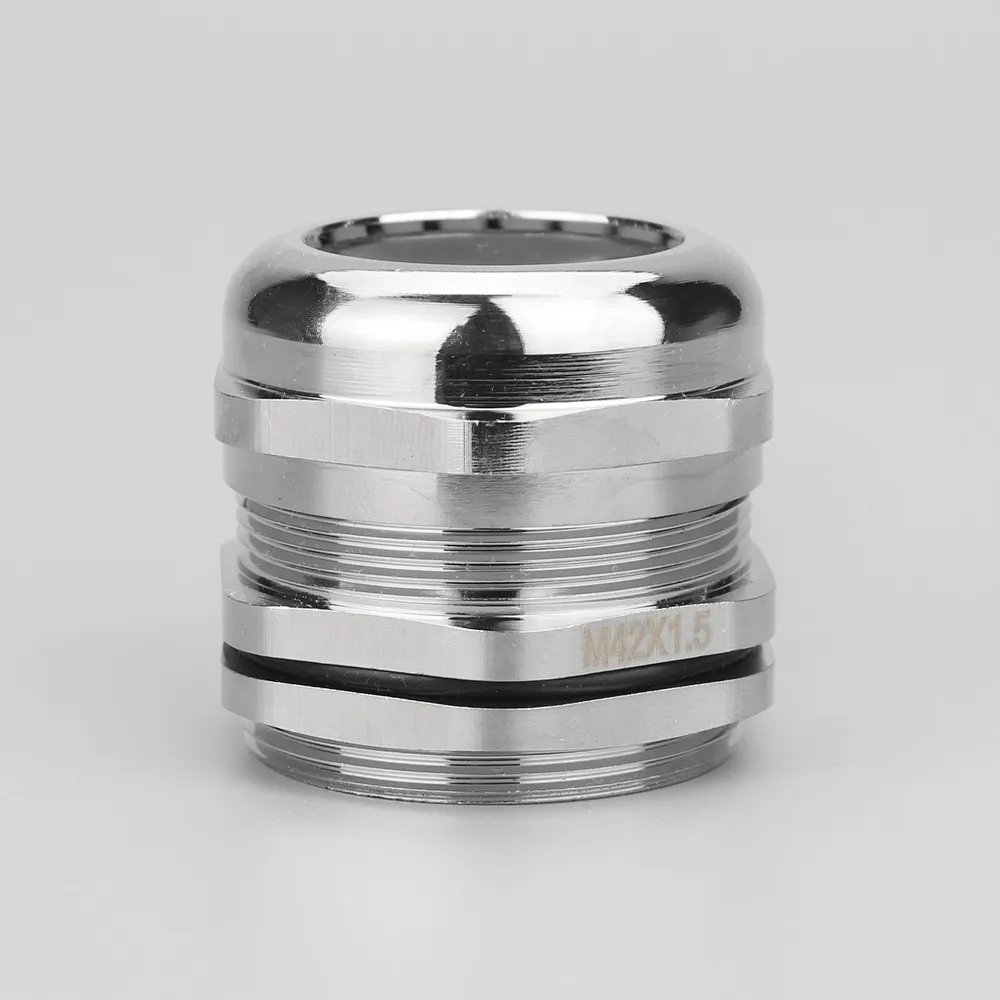
| M42-EMC | M42×1.5 | 22–30 | 42 | 42-42.2 | 11 | 45 |
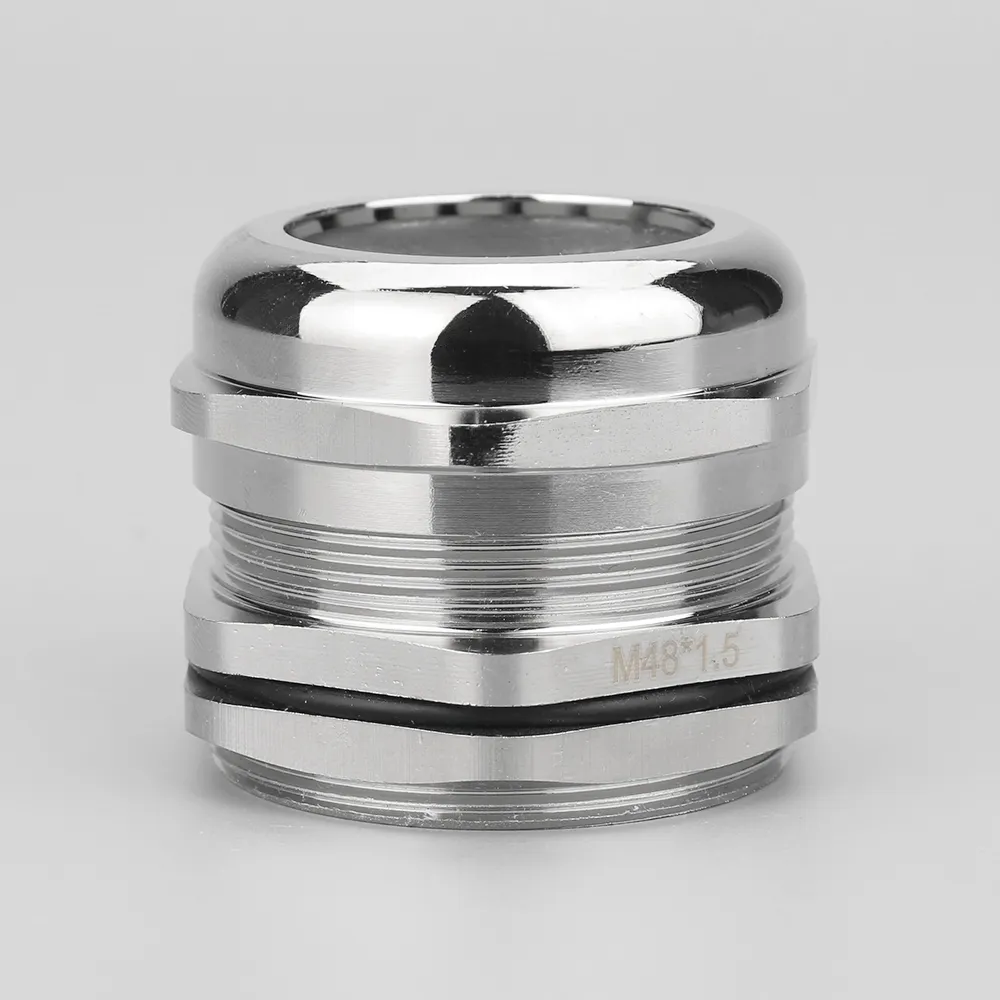
| M48-EMC | M48×1.5 | 25–33 | 48 | 48-48.2 | 11 | 50/52 |
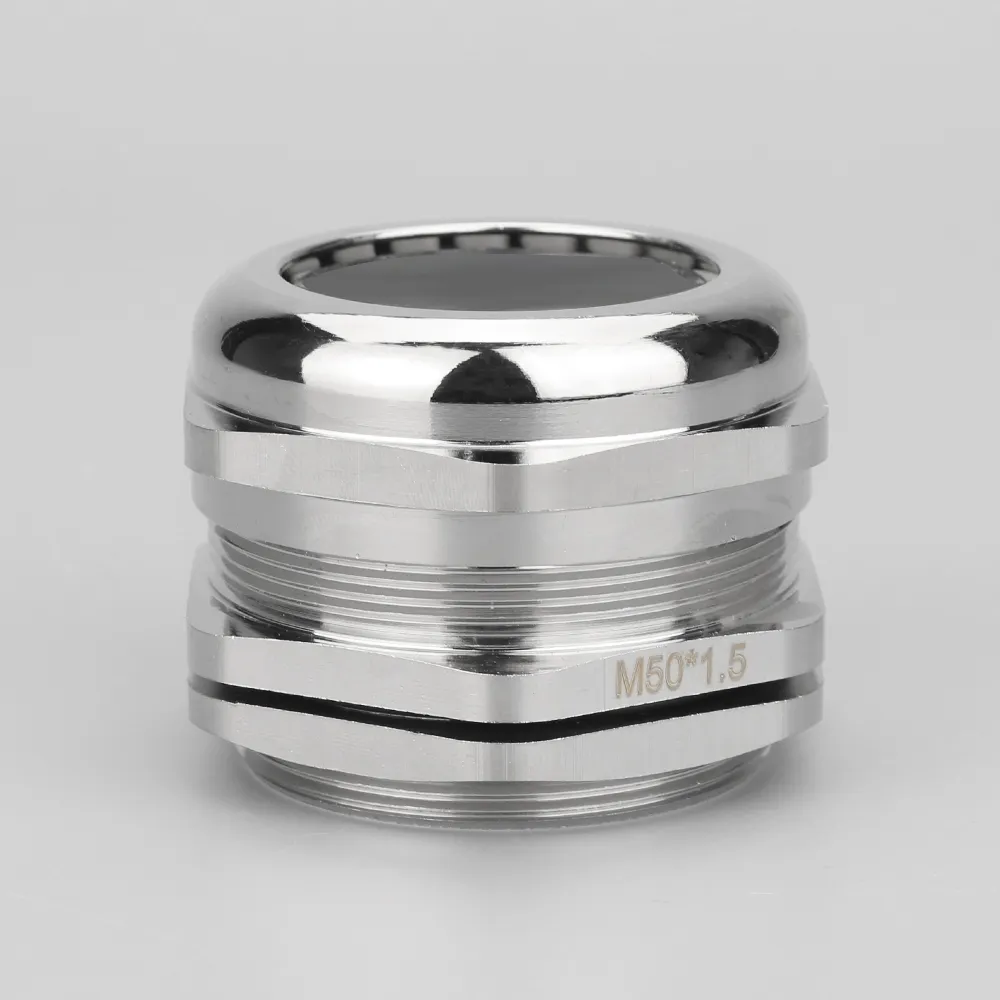
| M50-EMC | M50×1.5 | 32–38 | 50 | 50-50.2 | 12 | 57/55 |
| M63-EMC | M63×1.5 | 37–44 | 63 | 63-63.2 | 13 | 64/68 |
Metric series M14 to M63. Mounting hole equals thread O.D. plus 0.2 mm, the same as the standard brass series, so an existing hole can take either gland.
PG series: PG7 to PG63
| الطراز | Thread AG | Cable range (mm) | عمق اللولب (مم) | Mounting hole (mm) | Thread length GL (mm) | حجم مفتاح الربط (مم) |
|---|---|---|---|---|---|---|
| PG7-EMC | PG7 | 3–6.3 | 12.5 | 12.5-12.7 | 7 | 14 |
| PG9-EMC | PG9 | 4–8 | 15.2 | 15.2-15.4 | 8 | 18 |
| PG11-EMC | PG11 | 5–10 | 18.6 | 18.6-18.8 | 8 | 20/21 |
| PG13.5-EMC | PG13.5 | 6–12 | 20.4 | 20.4-20.6 | 8 | 22 |
| PG16-EMC | PG16 | 10–14 | 22.5 | 22.5-22.7 | 9 | 24 |
| PG19-EMC | PG19 | 10–14 | 25 | 25-25.2 | 9 | 24/27 |
| PG21-EMC | PG21 | 13–18 | 28.3 | 28.3-28.5 | 9 | 30/32 |
| PG25-EMC | PG25 | 15–22 | 32 | 32-32.2 | 10 | 35 |
| PG29-EMC | PG29 | 18–25 | 37 | 37-37.2 | 11 | 40 |
| PG36-EMC | PG36 | 25–33 | 47 | 47-47.2 | 12 | 50 |
| PG42-EMC | PG42 | 32–38 | 54 | 54-54.2 | 13 | 57 |
| PG48-EMC | PG48 | 37–44 | 59.3 | 59.3-59.5 | 14 | 64 |
| PG63-EMC | PG63 | 42–52 | 72 | 72-72.2 | 15 | 78 |
PG series PG7 to PG63. Overall length is longer than the standard gland at the same thread because of the contact chamber; request the EMC datasheet for the exact figure.
Specify the shield diameter, not just the cable OD
This is the most common EMC ordering error. The gland makes two independent fits: the seal closes on the outer sheath, and the spring closes on the shield. A cable with a thick jacket and a small braid can sit comfortably inside the stated cable range and still make poor contact, because the spring is reaching past the shield into air.
Quote both dimensions — sheath OD, and shield OD measured after the jacket is stripped — and the size becomes unambiguous. Where the shield diameter sits near the bottom of the spring’s travel, say so; the insert can be matched at production rather than discovered on site.
التركيب
- Fit the body and locknut. On a coated enclosure, remove the coating at the thread face or fit an earth tag under the body.
- Strip the outer jacket to the length marked on the gland. Keep the braid intact and fold it back over the clamping insert.
- Slide the cable through the cap and the contact spring. The fingers stay open until the cap is tightened.
- Tighten the cap to compress the spring onto the braid, then check that the sheath seal is evenly compressed with no insert extruded.
- Verify continuity from braid to enclosure. A reading that changes when the cable is flexed means the contact is not seated correctly.
The full sequence, including the bonding check, is in the EMC gland installation guide. Where the cable is a motor lead, the VFD cable gland notes cover the additional requirements for drive output cables.
Where EMC glands are used
- VFD and servo motor cables, where the drive output is the dominant noise source
- Analogue instrumentation and signal loops running near contactors or switching gear
- Control panels for welding, induction heating and radio-frequency plant
- Rail, marine and offshore installations where screened cable is mandatory
- Data and communication cabinets sharing a panel with power equipment
If the requirement is only mechanical protection or water sealing, an EMC gland adds cost without benefit; the standard brass cable gland series covers that case, and the difference between the two designs is set out in the EMC versus standard gland comparison.
Ordering
Give thread system and size, cable OD, shield OD and quantity. Standard brass sizes are 1,000 pcs per size for factory pricing with no tooling charge, trial orders from 100 to 500 pcs, and stainless or special threads from 300 pcs. Locknuts, earth tags and sealing washers are quoted on the same line as the gland so nothing arrives short.
Frequently asked questions
Is an EMC cable gland the same as a shielded cable gland?
In practice the terms are used interchangeably, and both describe a gland that terminates the shield as well as sealing the entry. The distinction worth making is construction: a spring-contact gland touches the braid around its full circumference, while a gland that relies on an earth tag or a clamp screw touches it at one point.
Can a standard brass gland plus an earth tag do the same job?
Only at low frequency. An earth tag bonds the gland body to the enclosure, but the braid still has to reach that body, usually through a pigtail. The pigtail adds inductance, and shielding effectiveness falls away above a few megahertz, which is precisely where drives and switching supplies emit.
Does it work with foil-shielded cable?
Yes, with one condition: the foil needs a drain wire or a folded contact surface that the spring can reach. Foil alone is too thin and too easily torn to be clamped directly, so specify a cable with a drain wire, or use a foil-plus-braid construction.
Send thread, cable OD, shield OD and quantity for a same-day price. Samples of 1 to 2 pieces are available for verification.
اطلب عرض أسعار الآن
سيقوم فريقنا بالرد عليك خلال 24 ساعة.