Prensaestopas estanco
Waterproof Nylon Cable Gland for Industrial Cable Entry
Learn how to choose a waterproof nylon cable gland by thread type, cable range, IP68 sealing, and application needs for OEM, export, and bulk buying.
Seguir leyendo
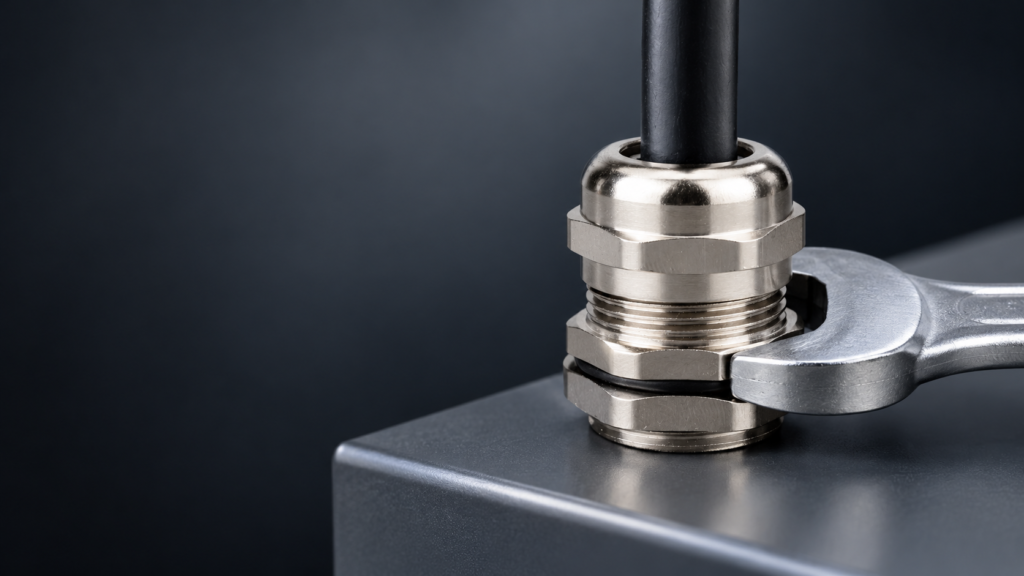
There is no torque value you can memorise and apply to every cable gland, and any page that gives you one number for “a cable gland” is describing one product in one size with one seal compound. Tightening has to achieve three things — compress the seal, clamp the cable, and keep both under vibration — and the force that achieves them changes with the thread size, the seal material and whether the body tightens onto a shoulder or onto the panel.
What you can standardise is the method: tighten until the seal is compressed and the cable will not move, stop before the seal is permanently deformed, and verify the result rather than the tool reading. This guide covers what determines the figure, how to read the figure your supplier gives you, and how to sign off a gland that was tightened by hand.
Three jobs, done by two different parts of the gland, and they interact.
| Job | Done by | Result if underdone | Result if overdone |
|---|---|---|---|
| Seal against water and dust | Sealing insert compressed by the dome nut, plus the panel gasket | Path along the cable or past the panel face | Insert extruded or split; seal destroyed |
| Grip the cable | Same insert, or a separate clamping ring | Cable moves, armour or screen takes the load | Cable jacket crushed, conductors deformed |
| Stay put | Thread engagement and the locking feature | Gland backs out under vibration | Thread stripped, body cracked |
The conflict is built in. The same tightening force that compresses the insert also deforms the cable and loads the thread. There is a window where all three jobs are satisfied and it is narrower than most fitters assume, especially on small threads where the difference between “sealed” and “stripped” is a fraction of a turn.
Five variables move the correct figure, and only one of them is under the installer’s control.
| Variable | Effect on the required torque | Who decides it |
|---|---|---|
| Thread size | Larger threads tolerate and usually require more torque; the load path is bigger | Specifier |
| Seal compound and hardness | A harder or thicker seal needs more force to compress the same amount | Supplier |
| Body material | Brass and stainless steel take different loads before the thread yields; nylon caps deform at much lower values | Specifier |
| Shoulder or no shoulder | A metal-to-metal stop ends the travel and makes the figure less critical; a purely elastomer stop does not | Product design |
| Cable position in the range | A cable at the bottom of the range needs less compression than one at the top for the same seal | Installer |
Because four of those five are fixed by the part and one by the cable, a torque figure only means something when it is stated per size and per seal material. A single number on a catalogue page is not a specification; it is an average of a range the supplier has not disclosed.
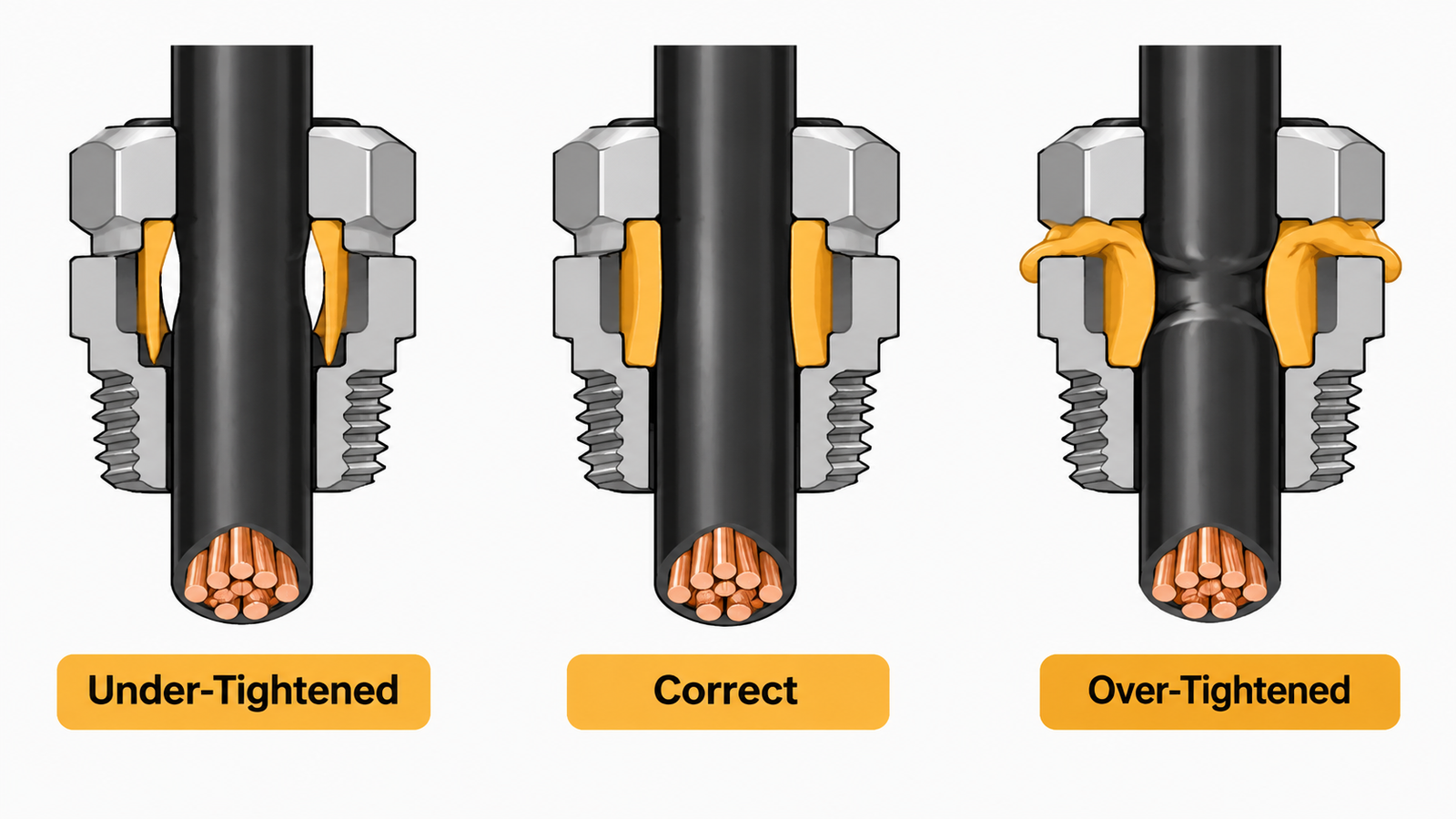
An under-tightened gland passes a visual inspection, passes a pull test done by hand at commissioning, and fails in service. The seal is in contact but not compressed, so it holds against splash and loses against a pressure differential, thermal movement or a cable that is pulled at an angle.
Over-tightening is the more destructive of the two and it usually happens for a good reason — the fitter is correcting a leak by adding force. Four things break, in this order.
| What fails | Visible sign | Consequence |
|---|---|---|
| Sealing insert | Rubber pushed out around the cable or past the nut | Seal extruded out of the gap it was meant to fill; leaks more than before |
| Cable jacket | Waist or dent in the jacket under the insert | Insulation damage, water path, loss of bend radius |
| Dome nut or body | Crack at the thread root, or a nut that spins freely | Gland scrap, and a leak that cannot be tightened away |
| Panel thread or gasket | Gasket squeezed thin on one side, thread stripped in a cast box | Panel damage; the entry needs rework, not a new gland |
Past a certain point, more torque makes the seal worse: the elastomer has a fixed volume, so squeezing beyond its elastic limit moves it sideways into the clearance instead of pressing harder on the cable.
When a supplier does publish a figure, six things have to be pinned down before it can be used. Ask for all six in writing; a figure without them is a number looking for a purpose.
Our own datasheets list the dimensional columns per size; where a tightening figure is needed we quote it per size and per seal compound on request rather than publishing a blanket number. That is the honest position for a range that spans M14 to M63 in three body materials.
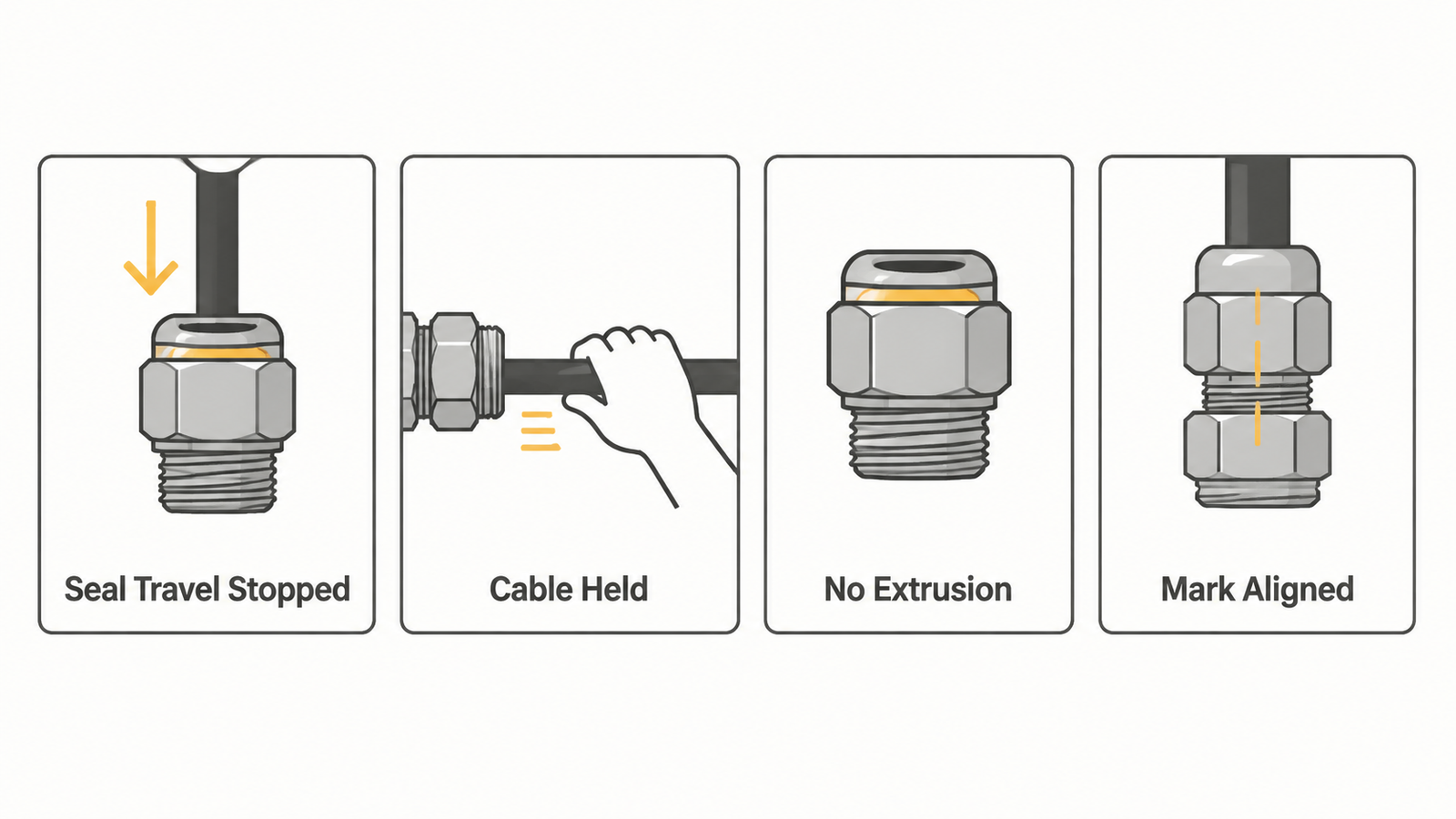
Most glands in the world are tightened by hand with a spanner. What works is a repeatable method with an observable end point.
En installation guide covers the sequence around this step, and the installation precautions list the handling errors that make a correctly torqued gland leak anyway.
Order matters as much as force. On a single compression gland there is one joint; on a double compression gland the inner seal has to be set before the outer one, because tightening the outer first drags the inner assembly and leaves it under-compressed. That sequence, and why it cannot be reversed, is covered in the single vs double compression comparison.
Re-torque is a separate decision. Elastomers take a permanent set after the first thermal cycles, so a gland that was correct when it was made can be loose a month later — which is why the second visit matters more than the first. Re-check after the first heat cycle on equipment that runs hot, and at the first scheduled maintenance on anything exposed to vibration or weather. Do not re-torque on a schedule for its own sake; re-torque where the joint has a reason to relax.
If the assembly is safety-related, on an Ex installation, or subject to a customer witness test, the requirement belongs in the order rather than in a conversation.
| Order line | What to write |
|---|---|
| Tightening specification | Per size and per seal compound, with the component named |
| Thread condition | Dry or lubricated, and whether anti-seize is permitted |
| Verification | Torque wrench on a sample, or documented hand method with acceptance criteria |
| Records | Which glands were checked, by whom, at what value — for the maintenance file |
Two cautions. On hazardous area work the tightening specified in the certification documents overrides anything in this article or in a general catalogue, and the thread engagement is part of the certification rather than a workmanship preference. And on stainless steel bodies, thread galling can seize a joint before the correct torque is reached — the answer is a suitable lubricant approved for the environment, not more force.
It depends on the size, the seal material and the body material, and it is quoted per size by the supplier. Anyone giving a single figure for all glands is quoting a specific product, not a rule.
Yes, if the end point is judged from the seal rather than the effort. Hand plus a defined fraction of a turn, checked by trying to move the cable, is more reliable than a torque wrench used without knowing what the figure refers to.
Because the seal has probably been extruded. Beyond the correct compression the elastomer moves into the clearance instead of pressing on the cable, and the joint gets worse with every extra turn. Replace the insert rather than adding force.
After the first thermal cycle on hot equipment, and at the first service interval on vibrating or weather-exposed installations. Elastomers take a permanent set, so the joint that was correct at assembly can be loose later.
The load path changes, so the figure does. A locknut provides the reaction point instead of a threaded boss, and the panel thickness between them becomes part of the joint.
If you tell us the size, the seal compound and the cable, we will return the tightening figure for that combination along with the dimensional data from the thread size chart and the hole required from the hole size chart. The brass y nylon ranges have different limits, and the IP rating guide explains what the seal has to achieve once it is tight.
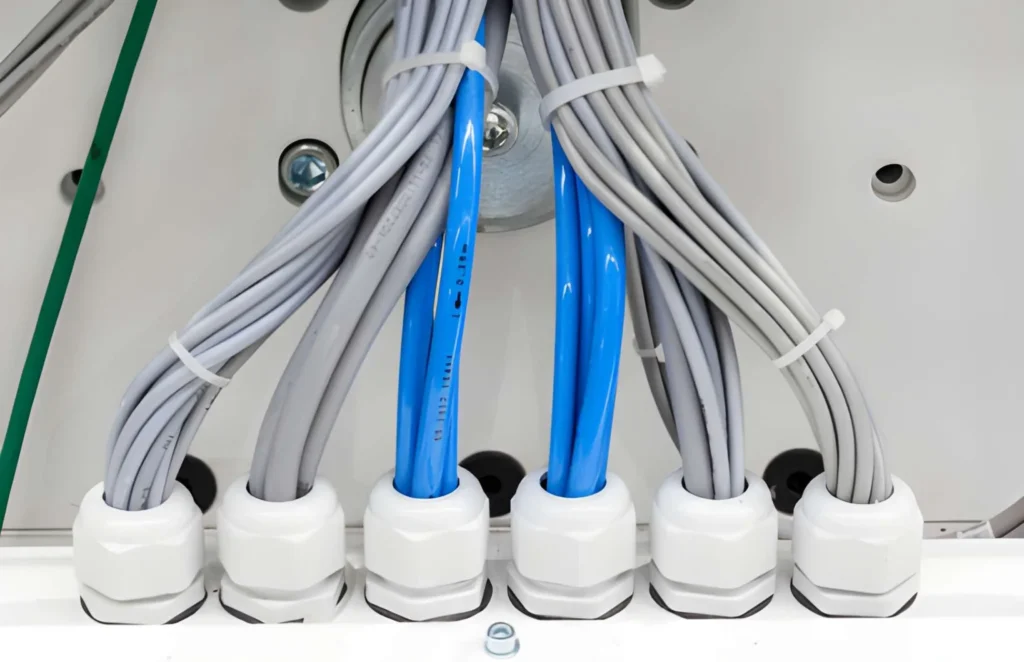
Learn how to choose a waterproof nylon cable gland by thread type, cable range, IP68 sealing, and application needs for OEM, export, and bulk buying.
Seguir leyendo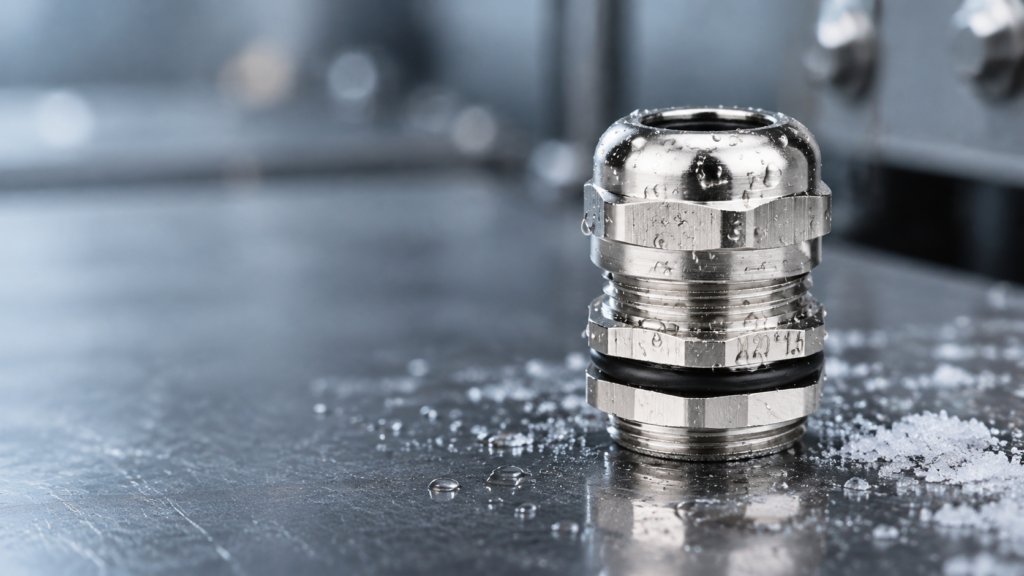
Nickel plating is a barrier and a hard surface, not a change of material. How thickness, process and salt spray claims actually read, where plating fails on site, and when to move to stainless instead.
Seguir leyendo
¿Alguna vez le ha costado elegir el prensaestopas adecuado? No se preocupe, no es el único. Puede que los prensaestopas sean pequeños, pero desempeñan un papel fundamental a la hora de garantizar la seguridad y estabilidad de sus sistemas eléctricos. Tanto si se dedica a la automatización industrial como a la petroquímica o la ingeniería naval, la elección de un prensaestopas incorrecto puede provocar fugas de agua, cortocircuitos [...].
Seguir leyendo