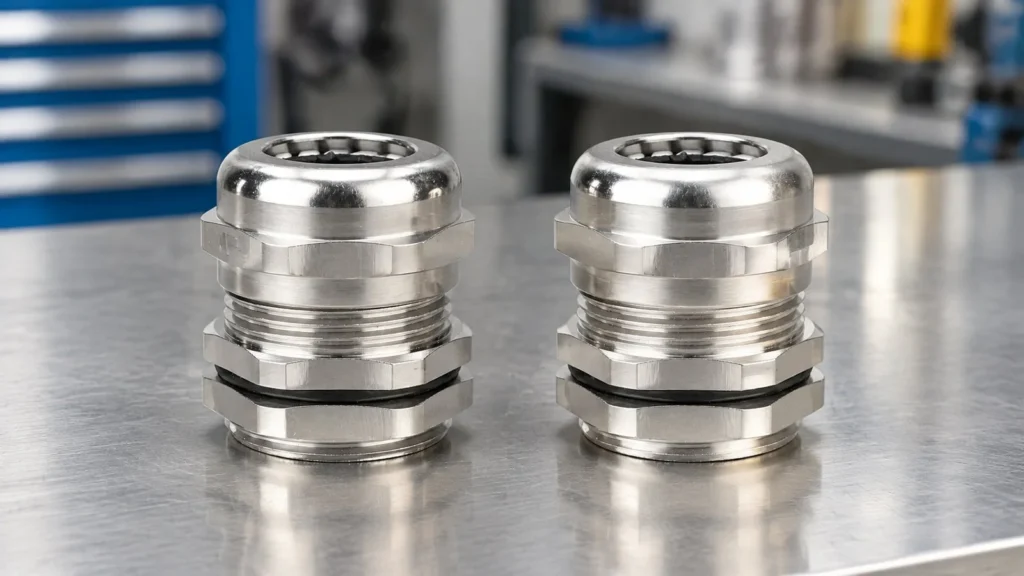
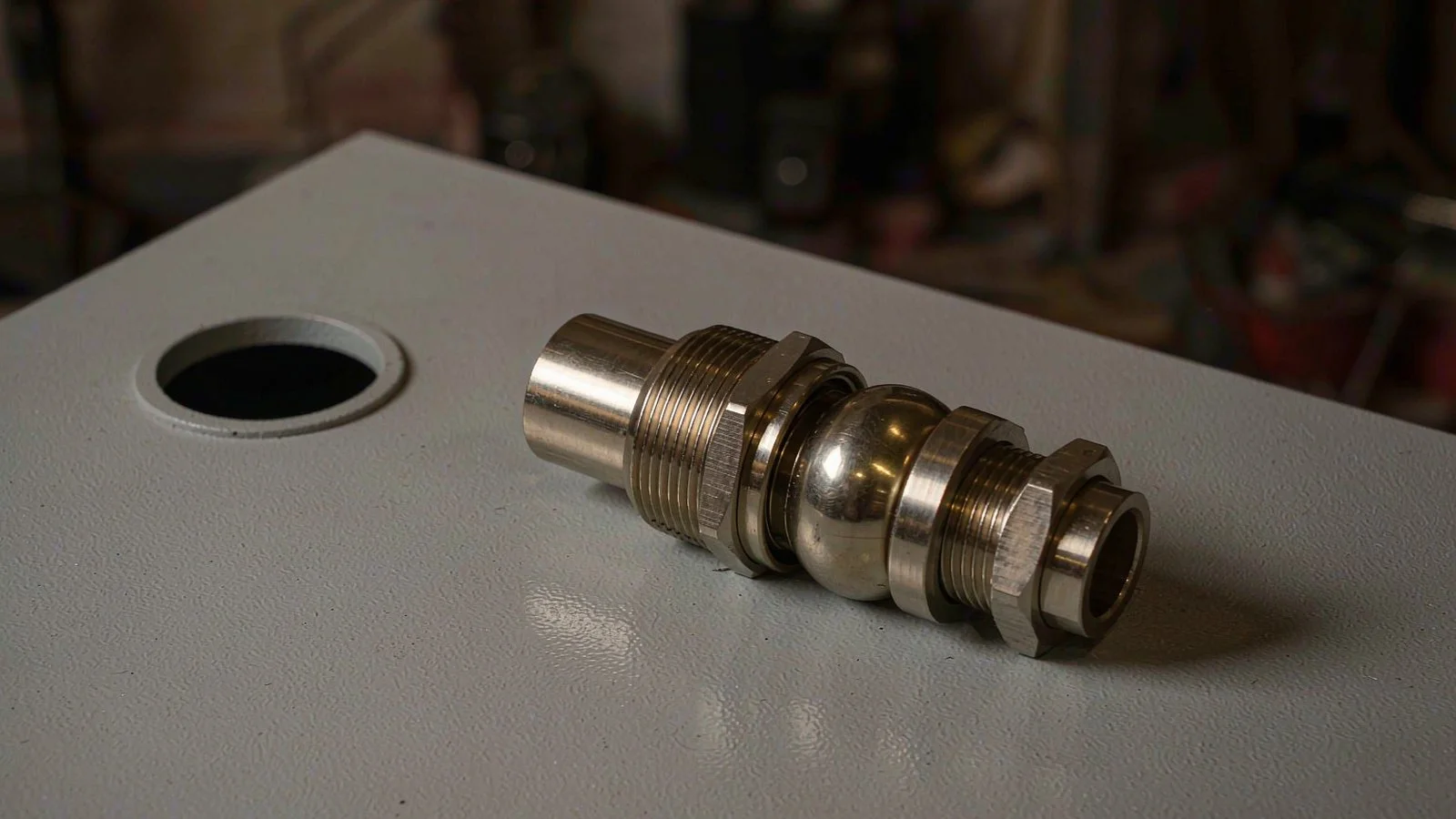
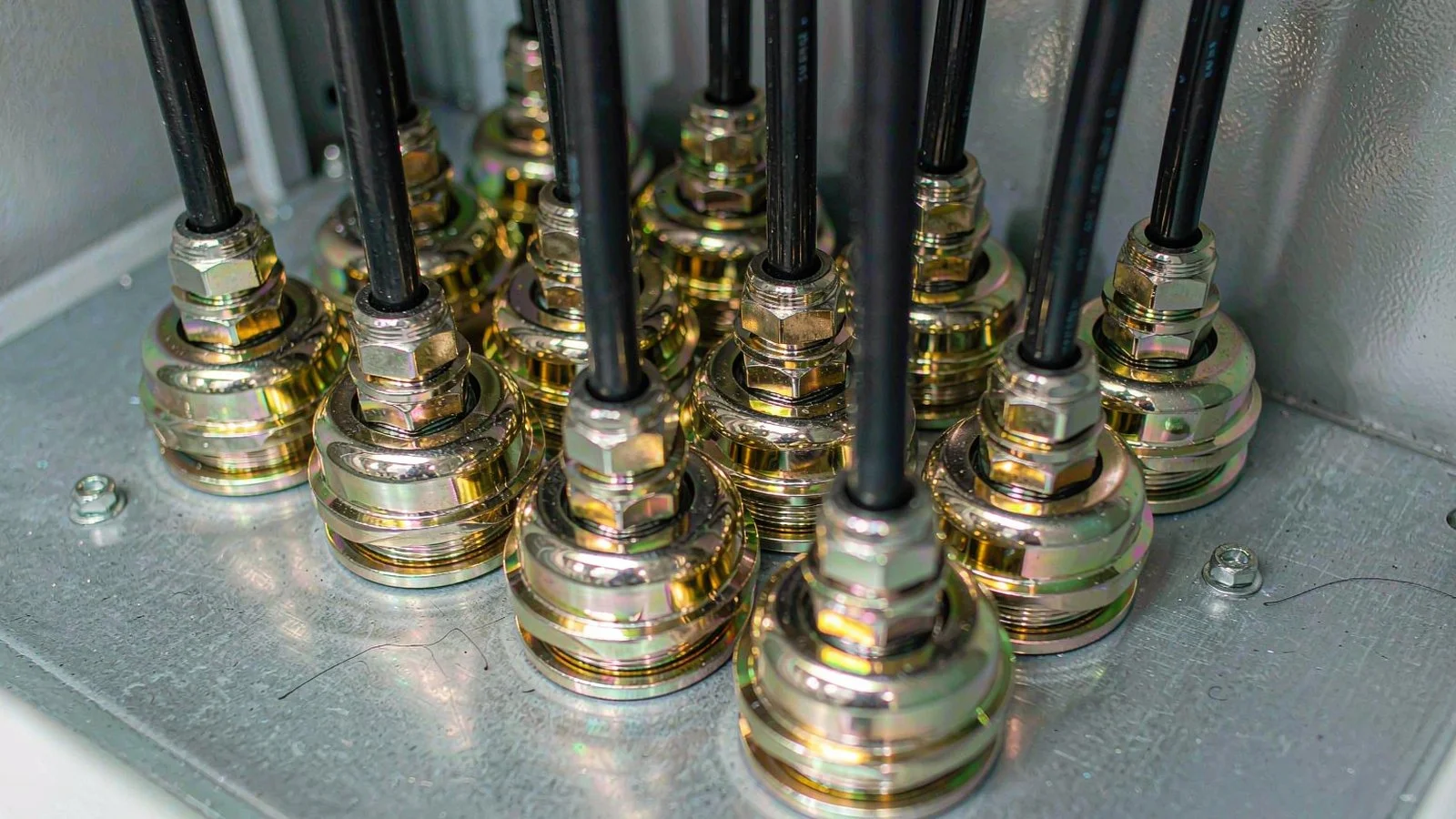
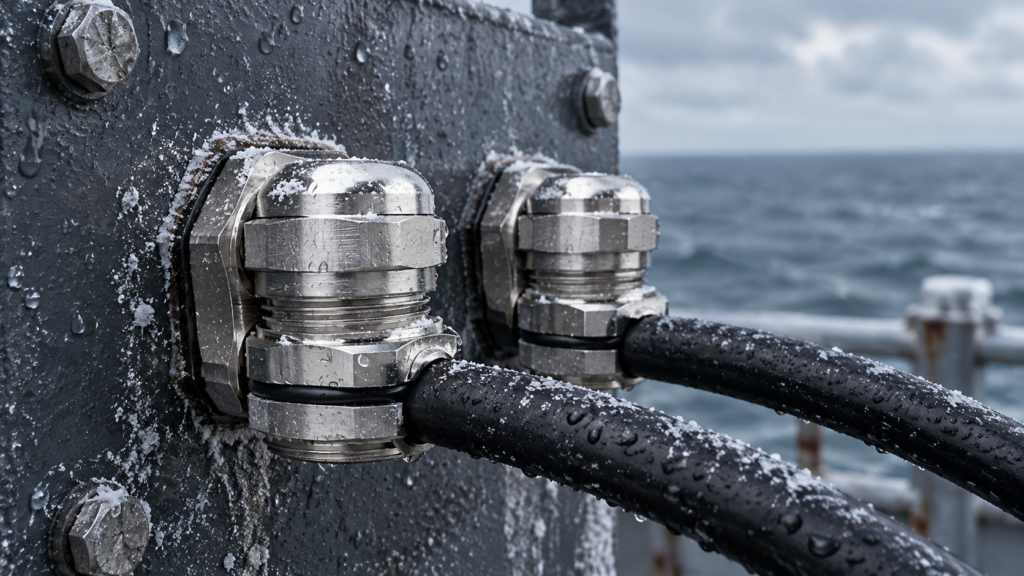
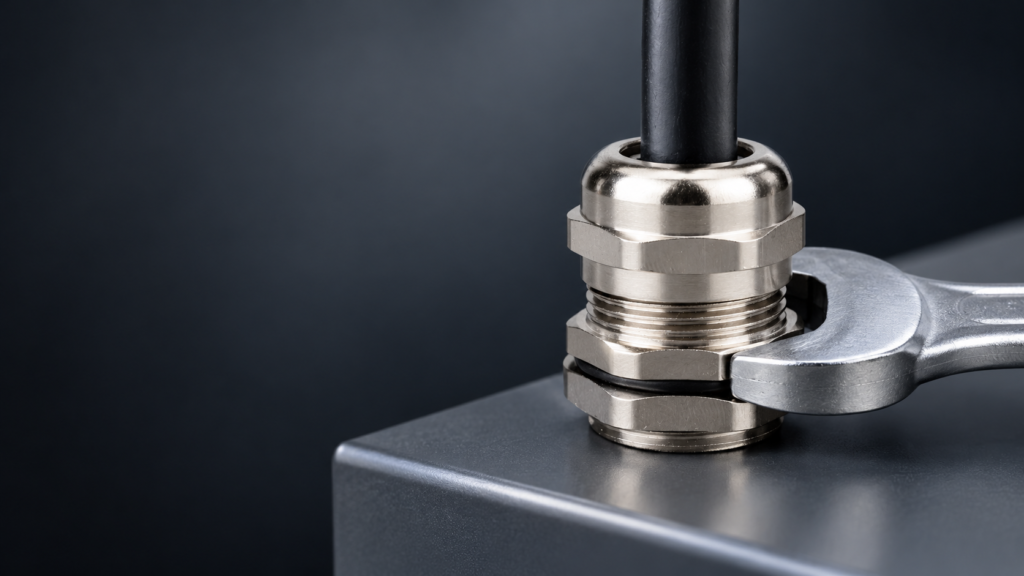
“PG21 vs M20” is searched often enough to look like a real comparison. It is not. The two threads are 8.3 mm apart, they clamp cable ranges that do not touch, and no enclosure can sensibly be drilled for both. The gland PG21 actually competes with sits 0.3 mm away, and that decides whether it enters the hole you have.
This page takes PG21 apart the way we do for every size: the published numbers, the two neighbours that matter, and what happens at the hole when you mix them up. Values come from our dimensional table for the standard nickel plated brass part.
The Numbers That Define a PG21 Gland
Parámetro
PG21 standard gland
What it decides at the panel
Hilo
PG21, 80 degree thread form
Must match the locknuts and adapters already on the plant
Cable range
13 to 18 mm sheath O.D.
Your measured sheath must sit inside the band, not on its edge
Thread outside diameter
28.3 mm
The number the hole is derived from
Mounting hole
28.3 to 28.5 mm
Two tenths of clearance, no more
Thread length GL
9 mm
Must cover panel thickness plus washer plus locknut
Longitud de enlace
27 mm
Body length behind the panel
Spanner size
30 and 32 mm across flats
Two hexes in one assembly, so two wrenches
Note that the size designation is not a diameter. Twenty-one is a nominal figure from the older German system; the thread measures 28.3 mm across. Why the offset varies through the series is set out in our PG versus metric cable glands guide and the PG13.5 size guide.
Three Tenths of a Millimetre Above M28
The single most useful thing to know about PG21 is where it sits against the metric series. Its thread is 28.3 mm; M28 is 28 mm. The 0.3 mm difference is less than two folded sheets of paper, and it makes the two parts mutually exclusive in a finished panel.
Two consequences follow. A hole drilled to the M28 specification, 28 to 28.2 mm, will not accept a PG21: the thread is larger than the hole. A hole drilled to the PG21 specification, 28.3 to 28.5 mm, will accept an M28, but with 0.15 mm of radial clearance all round. The second case is the dangerous one, because the gland goes in and the failure arrives later.
“PG21 vs M20” Is the Wrong Question
M20 clamps 6 to 12 mm cable, PG21 clamps 13 to 18 mm. There is no overlap, so nothing can be chosen on cable size, and the threads differ by 8.3 mm, so nothing can be chosen on the hole either. If you are holding both in your hand, the mistake is upstream.
Where the comparison does have an answer is the gap between them. A 12.5 mm cable sits above M20’s limit and below PG21’s, so neither serves it, and it is one of the few genuinely orphaned bands in the catalogue. That cable needs M22, M24, M25, PG16 or PG19, all of which clamp 10 to 14 mm. Our M20 cable gland size guide covers the lower side of that gap.
So treat “PG21 vs M20” as a symptom rather than a question. It usually means someone is moving a cable up one size on an existing panel and has picked the next gland they recognise rather than the next gland that fits the hole.
Three Glands, One Cable Range
At 13 to 18 mm the catalogue offers three parts, and they clamp identically. The table below is the comparison that actually matters for this size.
Part
Cable range
D.E. de la rosca
Mounting hole
GL
Longitud de enlace
Spanner
M28 × 1.5
13 to 18 mm
28 mm
28 to 28.2 mm
9 mm
27 mm
30 mm
PG21
13 to 18 mm
28.3 mm
28.3 to 28.5 mm
9 mm
27 mm
30 and 32 mm
M30 × 1.5
13 to 18 mm
30 mm
30 to 30.2 mm
9 mm
29 mm
30 and 32 mm
Six of the seven columns are effectively the same. The only column that separates these three parts is the mounting hole, and the three hole bands do not even touch: 28 to 28.2, then 28.3 to 28.5, then 30 to 30.2. There is no hole that accepts two of them.
That inverts the usual buying logic. For a 15 mm cable you cannot choose by cable, because all three take it. You choose by the hole you have, or, if you are drilling fresh, by what you want to stock. Anyone who says the answer depends on the cable has not read the range column.
The metric series does something similar nearby, and worse: M32 and M33 are both 15 to 22 mm. Around this part of the range the metric ladder carries four sizes for two cable bands, while the PG ladder carries one size per band. That is an argument for standardising on PG in a legacy plant and on metric in a new one, but never for mixing them on one panel.
What 0.3 mm Does at the Hole
An undersized hole fails in the open. The thread will not start, the fitter reports it, the panel gets reamed and the job continues. This is the cheap failure and it is the reason 0.3 mm is not usually a disaster in one direction.
The oversized hole fails quietly, because the hole is not what seals. The face washer seals against the panel, not the bore, so a gland in a hole 0.15 mm too large still seals on installation day. What it loses is location: it can sit off centre, washer contact becomes one-sided, and on thin sheet with vibration the assembly can walk. That is a slow leak that gets blamed on the insert.
Which is why the hole deserves to be treated as a specification rather than a clearance you estimate on site. The drilling side, including what happens on thin sheet and what a burr does to the sealing face, is covered in our cable gland hole size chart.
One caution on tapped holes: 28.3 mm is a clearance hole for through mounting with a locknut. A tapped M28 or PG21 boss is a different calculation and belongs to whoever is cutting the thread, not to the gland table.
The hole is a specification, not a clearance. Three tenths of a millimetre of thread decides whether the gland starts.
The Ladder Either Side
PG sizes are closer together than metric sizes in this part of the range, which sounds helpful until you look at where the cable ranges actually move.
Size
D.E. de la rosca
Cable range
Step in cable range
PG16
22.5 mm
10 to 14 mm
—
PG19
25 mm
10 to 14 mm
No change
PG21
28.3 mm
13 to 18 mm
+4 mm on the top
PG25
32 mm
15 to 22 mm
+4 mm on the top
PG29
37 mm
18 to 25 mm
+3 mm on the top
PG19 buys 2.5 mm of extra hole and no extra cable, which makes it a rung you can skip unless the hole is the constraint. PG21 is the rung where the band finally moves, and it moves by four millimetres.
The overlaps are narrow in both directions. PG19 and PG21 share only 13 to 14 mm, the tightest overlap in the whole PG series; a 13.5 mm cable is therefore the only figure that leaves a genuine choice between them, and the choice is the hole. PG21 and PG25 share 15 to 18 mm, a comfortable three. And 14 to 15 mm belongs to PG21 alone, because PG19 stops at 14 and PG25 starts at 15.
At the top end, an 18 mm cable is clamped by PG21, by PG25 and by PG29, so once again the cable decides nothing. The PG29 size guide takes that conversation further up the ladder.
Thread Length 9 mm and the Panel Stack
Nine millimetres is shared with PG16 and PG19, and is two more than the small PG sizes carry. On a three millimetre plate with a four millimetre washer and locknut stack it leaves two millimetres of engagement, which is workable but tight; on a two millimetre plate it leaves three, which is comfortable.
What catches people is not the plate. It is the gland plate bolted over an existing wall, the raised pad on a cast box, or a locknut in a standard rather than thin pattern. All three add to the stack without appearing on the drawing, and all three are found when the body will not pull down onto the panel. The answer is a longer thread variant as its own part number, never a thinner nut.
The body behind the panel is 27 mm on PG21, matching M28 and two millimetres shorter than M30. That matters on a crowded box where the gland’s tail competes with terminal blocks for the same space.
Spanner 30 and 32, and the Clearance They Set
Two spanner values in one line item look like a typo and are not: the assembly has two hexes and they differ. In practice the installer needs both wrenches, and the counter-hold is what stops the body turning while the nut is tightened.
The 32 mm hex also sets the entry pitch. Adjacent glands must be far enough apart for a wrench to swing on the larger hex, and on a dense gland plate that spacing, not the gland diameter, limits how many entries fit.
Entry pitch is set by the 32 mm hex and the wrench that has to swing on it, not by the thread diameter.
Minimum order quantity for brass is normally 1,000 pieces per size with no tooling charge, and trial orders of 100 to 500 pieces are usually accepted at a slightly higher unit price. Stainless steel starts at 300 pieces per size.
Preguntas frecuentes
What size hole does a PG21 cable gland need?
28.3 to 28.5 mm. That is the thread outside diameter of 28.3 mm plus about two tenths of a millimetre of clearance.
What cable does a PG21 gland take?
13 to 18 mm sheath outside diameter. Measure the finished cable and work in the middle of that band rather than at either limit.
Is PG21 the same as M28?
No. The threads are 28.3 mm and 28 mm, with different thread forms. A PG21 will not enter a 28 mm hole, and an M28 locknut will not run properly on a PG21 thread.
Will a PG21 gland fit a 28 mm hole?
No. The thread is 0.3 mm larger than the hole, so it will not start. The panel has to be reamed to 28.3 mm, or the gland changed to M28.
Is PG21 available in stainless steel?
Yes. The same dimensions apply, including the 9 mm thread and the 28.3 mm hole, and stainless is quoted from 300 pieces per size. Our stainless steel range carries PG19 and PG25 in the same series.
Why 316 stainless steel cable glands fail at sea, and what the position of the entry has to do with it. Exposure zones, crevice corrosion, free iron, washdown and installation discipline.
An armoured cable gland must grip the armour, bond it to earth and seal the sheath. This guide covers armour types, BW / CW / E1W sealing stages, and how two cable diameters set the gland size.
Utilizamos cookies para mejorar su experiencia de navegación, publicar anuncios o contenidos personalizados y analizar nuestro tráfico. Al hacer clic en "Aceptar todo", aceptas el uso que hacemos de las cookies.