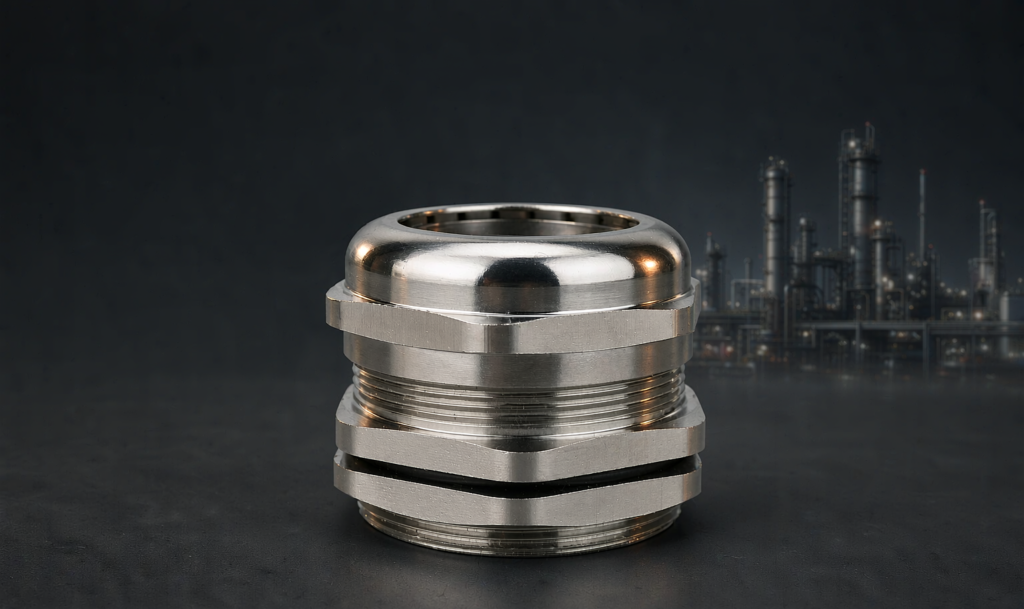
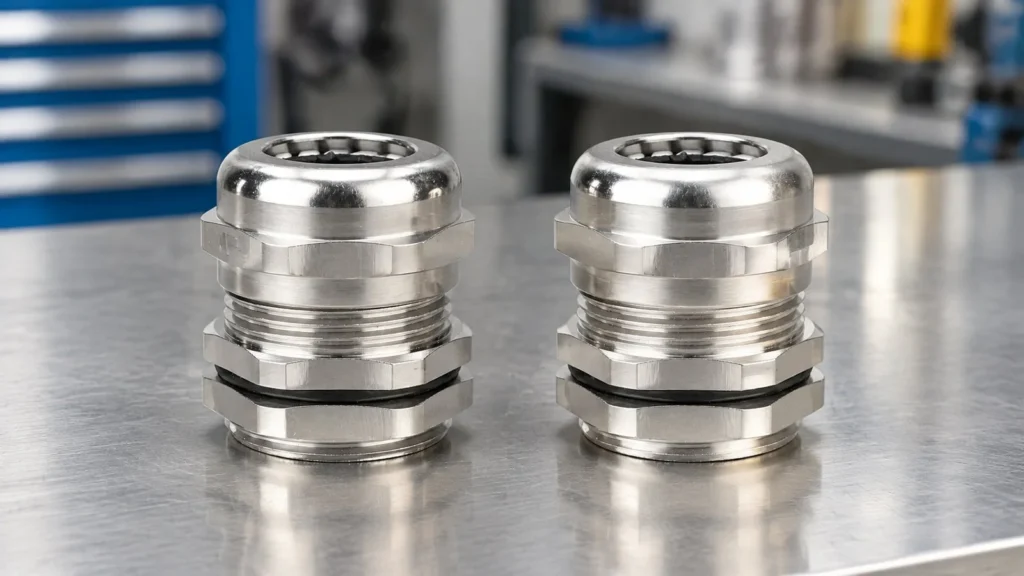
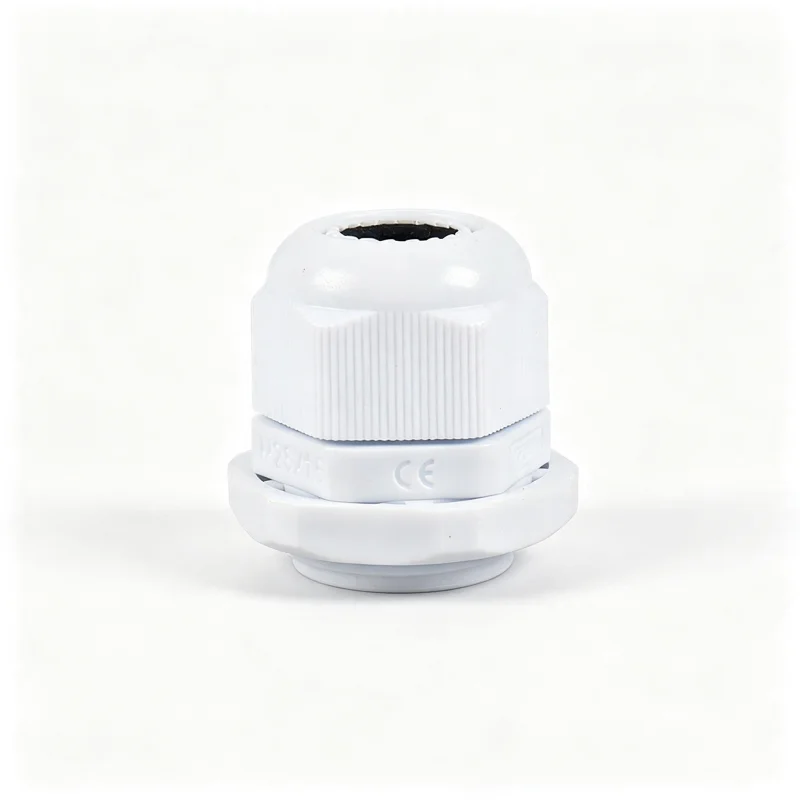
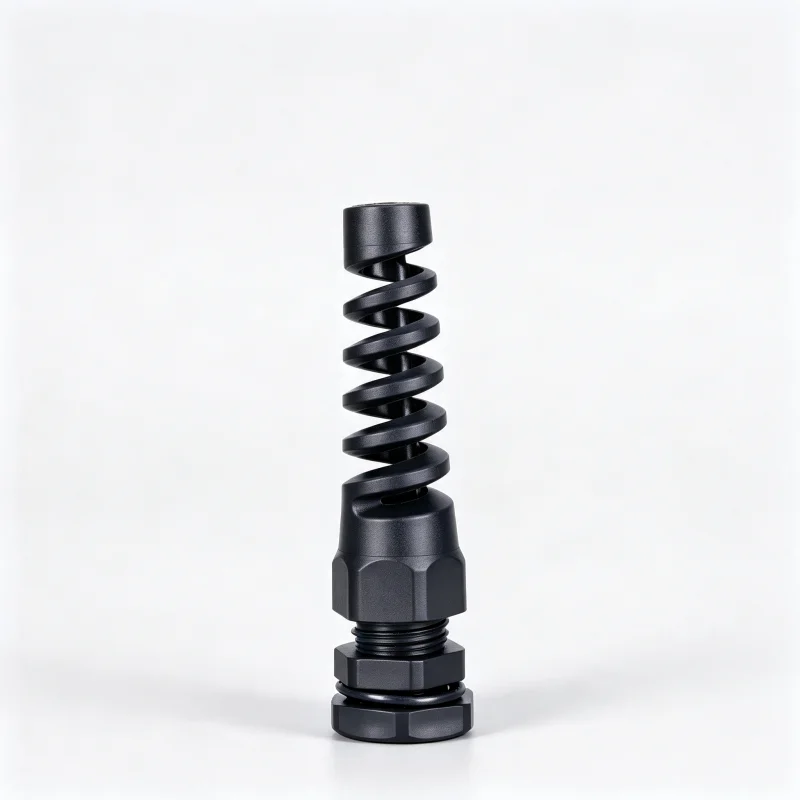
A cable gland washer is the cheapest part in the assembly and the one most often chosen after everything else has been specified. That order of work is why glands leak at the panel face while the cable entry stays dry. The washer is not a generic ring: its bore has to clear one specific thread, its outer diameter has to overlap one specific hole, and its compound has to hold compression for the life of the enclosure. Get any of those wrong and the gland is still watertight around the غدة الكابل body — it just is not watertight against the box.
What a Washer Seals
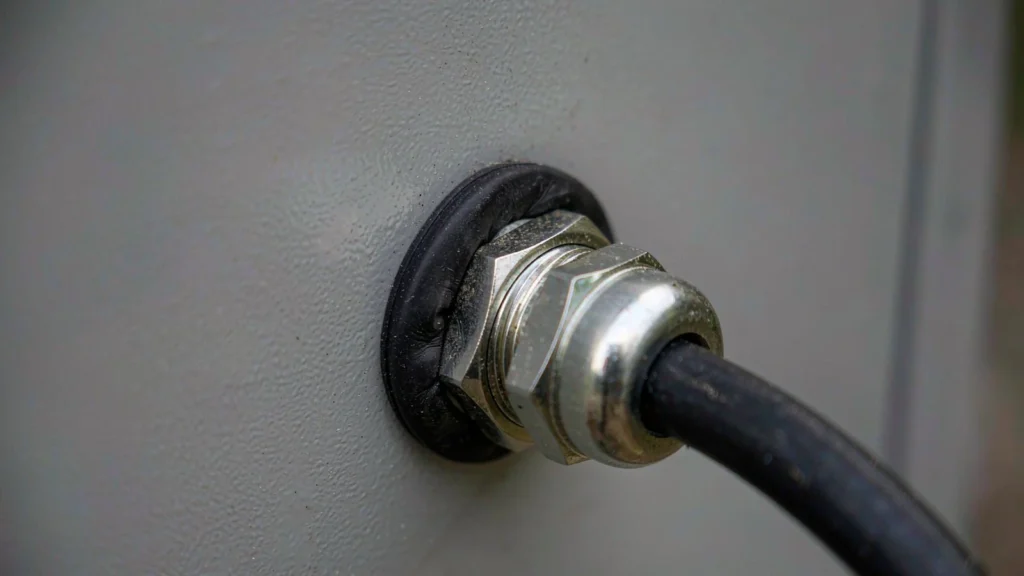
The washer seals the panel joint, not the cable. It sits between the body shoulder and the enclosure face and closes the annular gap where the thread passes through the wall. Its whole working life is spent under constant compression, with no movement to redistribute the load, so it is judged on compression set rather than on grip or hardness. Three dimensions decide whether it can do that: bore, outer diameter and thickness. A fourth property, the compound, decides whether it still has those dimensions in year five. On parallel-thread metric and PG glands this interface is the only barrier at the wall, because the thread itself seals nothing — it centres the body and carries the load.
Washer, Gasket and O-Ring
The three words are used interchangeably in quotations and describe different parts. A gasket is a flat part compressed between two faces. An O-ring is a torus squeezed inside a groove, where the groove controls how much it deforms. Both do the same job at the same interface on different body styles, and neither is a drop-in substitute for the other.
Part
Where it sits
What it seals
What it cannot do
Flat sealing washer
Compressed between body shoulder and panel face
The thread-to-panel joint
Seal the cable, or centre itself on an oversized hole
Bonded washer
Elastomer vulcanised onto a metal backing ring
Same joint, with a fixed outer diameter
Be reused once the elastomer separates from the backing
O-ring
In a machined groove on the shoulder, or a captive seat
Same joint, by controlled squeeze
Replace a flat washer where no groove exists
Moulded profile gasket
In a shaped recess on one body style
Same joint, on that body style only
Be swapped onto a body with a different recess
Serrated washer
Inside, under the locknut
Nothing — it conducts electricity
Be used as a seal anywhere in the stack
The practical consequence is that a spare-parts bin labelled “washers” is usually a mixture of all five. Sorting by size alone will not separate the sealing ring from the bonding ring, and the two are dimensionally close enough to fit each other’s place.
Stack Order Through the Wall
From the outside in, a clearance-hole entry runs: body shoulder, sealing washer, enclosure face, optional earth tag, locknut. The washer is the only part in that series that must contact the panel over its full annular width, so nothing may be inserted between washer and panel face. An earth tag sits either outside under the body shoulder or inside under the locknut, depending on the drawing, and it interrupts the seal line in neither position. Put it between washer and panel and the assembly gains an uncontrolled gap plus a leak path, while still looking correctly fitted.
Face Seal vs Groove Seal
A flat washer works by being crushed between two faces, and the amount of crush is whatever the locknut delivers. That is a crude control, which is why the washer has to be thick enough to absorb variation in a painted, welded or slightly dished panel. An O-ring cannot work that way: it needs a groove whose depth sets the squeeze, and if it is compressed like a flat washer it extrudes and takes a permanent set. The two are therefore body-specific. A gland with a groove demands the O-ring that fits it; a gland with a plain shoulder demands a flat or bonded washer. Fitting the wrong one produces a joint that passes a bench test at atmospheric pressure and fails the first time the enclosure sees a temperature swing.
Washer Bore and Hole Fit
The bore is set by the thread outside diameter, not by the nominal size on the label. This is where mixed thread systems cause quiet failures, because two families overlap in diameter without being interchangeable.
Gland thread
مؤشر الترابط O.D.
Panel hole
Nearest other thread
What happens
M20 × 1.5
20.0 mm
20.0–20.2 mm
PG13.5 at 20.4 mm
PG13.5 washer passes over the thread and leaves a 0.4 mm ring unsealed
PG13.5
20.4 mm
20.4–20.6 mm
M20 at 20.0 mm
M20 washer will not pass the thread; forcing it distorts the bore
M25 × 1.5
25.0 mm
25.0–25.2 mm
PG19 at 25.0 mm
Bore is identical, so the washer is interchangeable
M40 × 1.5
40.0 mm
40.0–40.2 mm
PG29 at 37.0 mm
A PG29 washer cannot reach the hole edge; 3 mm stays open
M63 × 1.5
63.0 mm
63.0–63.2 mm
PG48 at 59.3 mm
3.7 mm gap — the washer drops toward the hole instead of seating
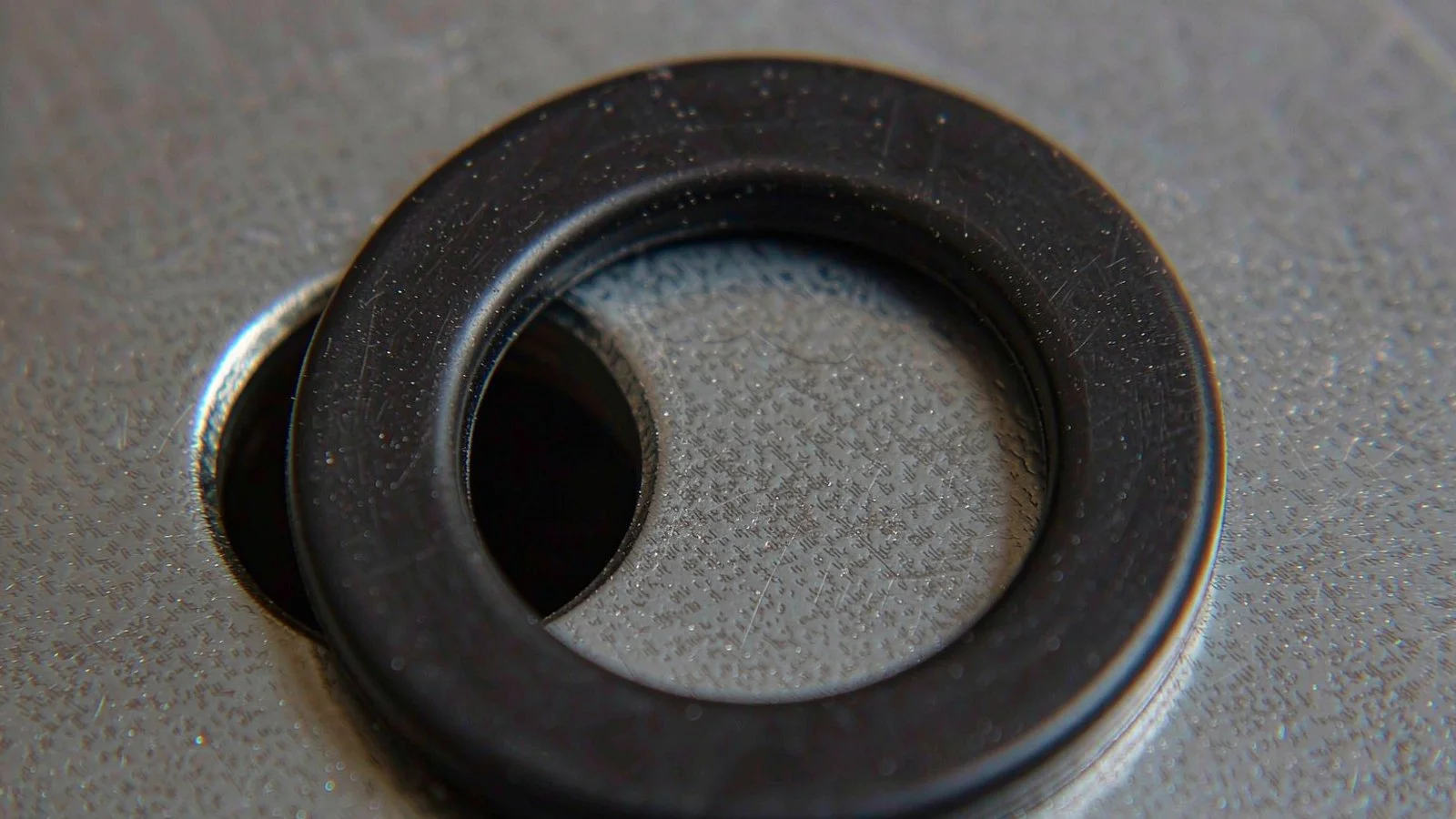
The second dimension is the outer diameter. A washer has to overlap the hole edge on every side, and panel holes are rarely as accurate as the gland. A hole drilled 1 mm over the drawing removes 0.5 mm of seating land all round, which on a small gland is a large fraction of the land it had. Before blaming the compound for a leak, measure the hole and the washer outer diameter — the hole size chart gives the designed figure for every thread, and the thread size chart gives the outside diameter the bore must match.
A washer only seals where it has material to sit on. Off centre like this, one side has no seating land at all.
Bonding Washers Are Not Seals
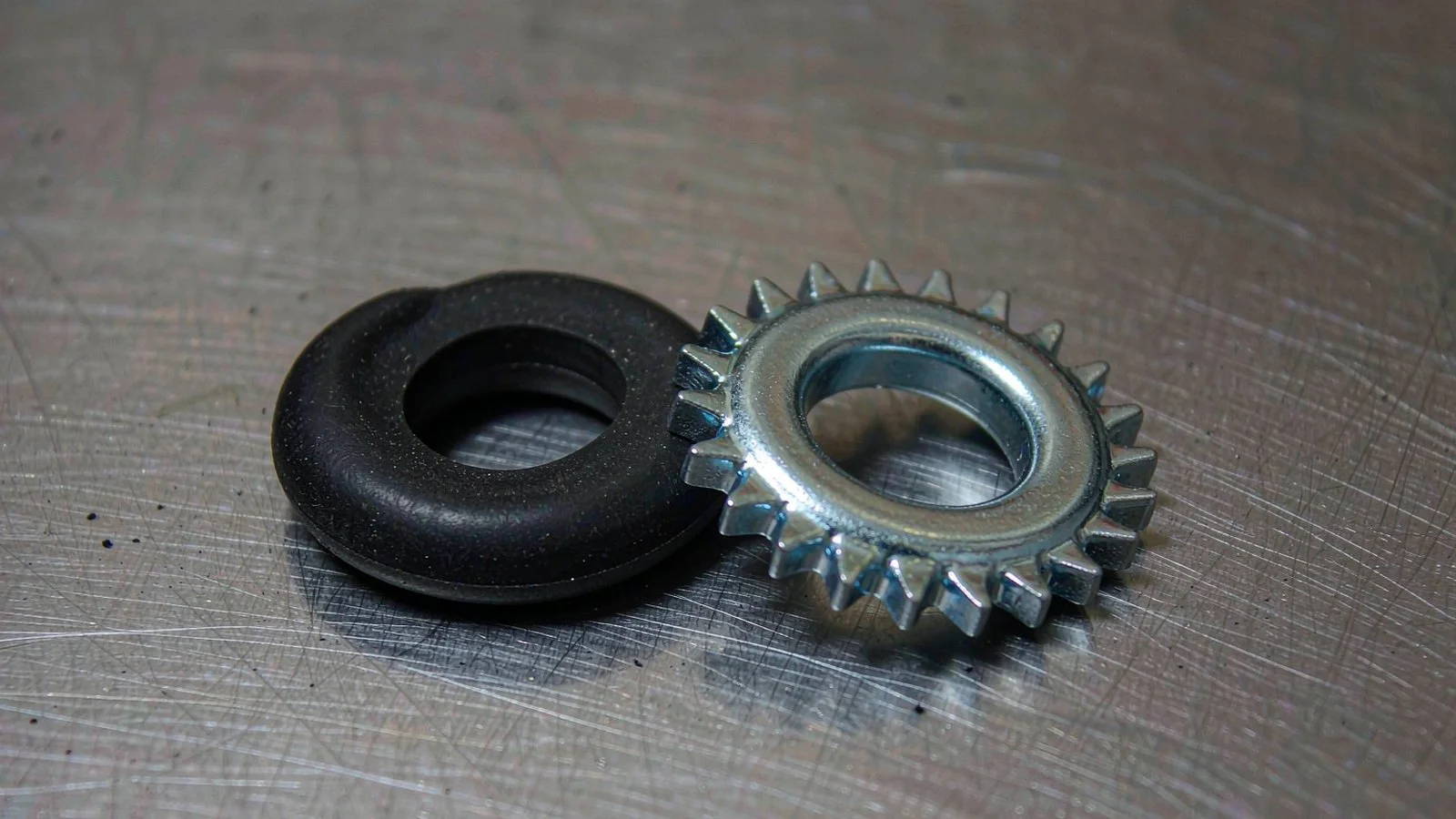
Serrated and toothed washers belong to the earthing circuit, not the sealing one. Their teeth are designed to cut through paint, anodising and oxide so that metal contacts metal, and cutting is the opposite of what a seal needs. Used as a seal they create dozens of micro-channels along the tooth edges. Used correctly they sit on the inside face under the locknut, where the only thing they have to achieve is low and stable resistance. The confusion runs both ways: no amount of tightening will make a toothed washer bond through a powder coating that is intact under the nut, and no flat washer will establish continuity across it. The circuit itself is a separate subject, covered in cable gland earthing and bonding.
Two rings from the same spares bin. Only the one on the left seals; the other is there to conduct.
Thickness and Thread Budget
Every millimetre of washer thickness is a millimetre of thread the locknut cannot use. The budget is the thread length minus washer, minus locknut, minus two exposed threads, and what is left has to cover the wall. On small sizes the arithmetic is tighter than most drawings assume.
الخيط
Thread length GL
Available wall, 1 mm washer and 3 mm nut
Available wall, 1 mm washer and 6 mm nut
M14 × 1.5
7 mm
0 mm
Not feasible
M16 × 1.5
8 mm
1 mm
Not feasible
M20 × 1.5
8 mm
1 mm
Not feasible
PG13.5
8 mm
1 mm
Not feasible
M25 × 1.5
9 mm
2 mm
Not feasible
M32 × 1.5
10 mm
3 mm
1 mm
PG29
11 mm
4 mm
2 mm
M63 × 1.5
13 mm
6 mm
4 mm
Two conclusions follow. Thin panels are not the problem people expect; thin panels with a thick washer and a standard nut are. And on M14 to M25 a standard washer plus a standard locknut consumes the entire thread, so those sizes are normally fitted into a tapped entry or with a thin nut. Where neither works, the answer is a longer thread, not a thinner seal.
Failure Signs by Seal
Which seal failed is usually visible on the part, provided you look before cleaning it. Water arriving along the cable is the insert. Water arriving at the panel joint is the washer. The evidence that separates them is where the corrosion and the water marks stop.
Symptom
Seal at fault
Evidence on the part
Damp at the panel face, dome nut interior dry
Panel washer
Washer hardened, holding a permanent flat shape, or an imprint of the hole edge only
Water inside the dome nut, panel face dry
Cable insert
Insert glossy, swollen or cracked; a polished ring on the sheath where it gripped
Leak on one side of the gland only
Panel washer, seating
Washer compressed unevenly — weld seam, burr or dished panel under one side
Rust streaks from under the body after a year
Panel washer, lost land
Washer outer diameter smaller than the hole edge; no continuous contact ring
Leak shortly after re-termination
Reused washer
Washer still holds the old compressed profile; it no longer has travel left
Continuity fails across a coated panel
Bonding, not sealing
Serrated washer missing or paint intact under the locknut
This table identifies the part. It does not tell you the order to work in when the water could have come from several places, which is what the leak diagnosis and repair sequence is for.
Spares, Sizing and Ordering
Order the washer by measured thread diameter, not by the label on the old gland. A gland marked M20 has a 20.0 mm thread; a gland marked PG13.5 has 20.4 mm, and both may have been described as 20 mm on a requisition. Measure across the thread with a caliper, then match bore and outer diameter together, because a correct bore with an undersized outer diameter seals nothing. Replace the washer whenever the gland is removed: after years under load the elastomer has taken a permanent set and has no travel left, which is why reused washers leak within weeks. Sealing parts are priced with the gland rather than as a separate accessory on our quotations, so the six components of a waterproof gland arrive as one article. Standard sizes are 1,000 pcs per size for brass and nylon with no tooling charge and trial orders from 100 to 500 pcs; stainless and hazardous-area versions run from 300 pcs per size. Compound options and their temperature limits are set out in the seal material comparison, and the four lines that belong on the purchase order are thread, bore, outer diameter and compound — a washer quoted as “M20 rubber” is not a specification.
Frequently asked questions
Should I replace the washer when I replace a gland?
Yes. An elastomeric washer that has been compressed for years has taken a permanent set and will not return to its original thickness. Reusing it is the most common cause of a leak appearing within weeks of a repair.
Can I use two washers to close a gap?
No. Stacking washers adds two uncontrolled interfaces and consumes thread length, and the outer washer is unsupported at its edge. If the panel is dished or the hole is oversized, fix the seating face or fit a larger gland.
Is an O-ring better than a flat washer?
Neither is better in general. An O-ring gives more predictable squeeze where the body has a groove to hold it; a flat washer tolerates a rougher panel face and more variation. The body design decides, not the preference.
What size washer does an M20 gland take?
A washer with a 20.0 mm bore, matching the M20 × 1.5 thread outside diameter. A PG13.5 washer has a 20.4 mm bore and will fit over the thread but seat with a gap, which is a leak path rather than a substitute.
Do I need a washer on an NPT gland?
On a taper thread the seal is made in the thread, so a washer is not the primary barrier. It is still specified on rough, painted or recessed faces, and it must be called out on the order — the body is pulled down as the thread engages, so thickness changes where the gland ends up.
تعرّف على كيفية تركيب غدد الكابلات المقاومة للماء من خلال أدلة تفصيلية خطوة بخطوة لإحكام غلق IP68 باستخدام غدد النايلون النحاسية أو الفولاذ المقاوم للصدأ من GHX.
Zone 1 and Zone 2 cable glands are selected from the area classification, not the catalogue. See how the zone sets the minimum EPL, what the gland marking must show, and the mistakes to avoid.
PG21 clamps 13 to 18 mm cable through a 28.3 to 28.5 mm hole, and its real competitor sits 0.3 mm away at M28. Why “PG21 vs M20” is the wrong question, and why the hole rather than the cable decides this size.
نحن نستخدم ملفات تعريف الارتباط لتحسين تجربة التصفح الخاصة بك، وعرض إعلانات أو محتوى مخصص، وتحليل حركة المرور لدينا. بالنقر على "قبول الكل"، فإنك توافق على استخدامنا لملفات تعريف الارتباط.