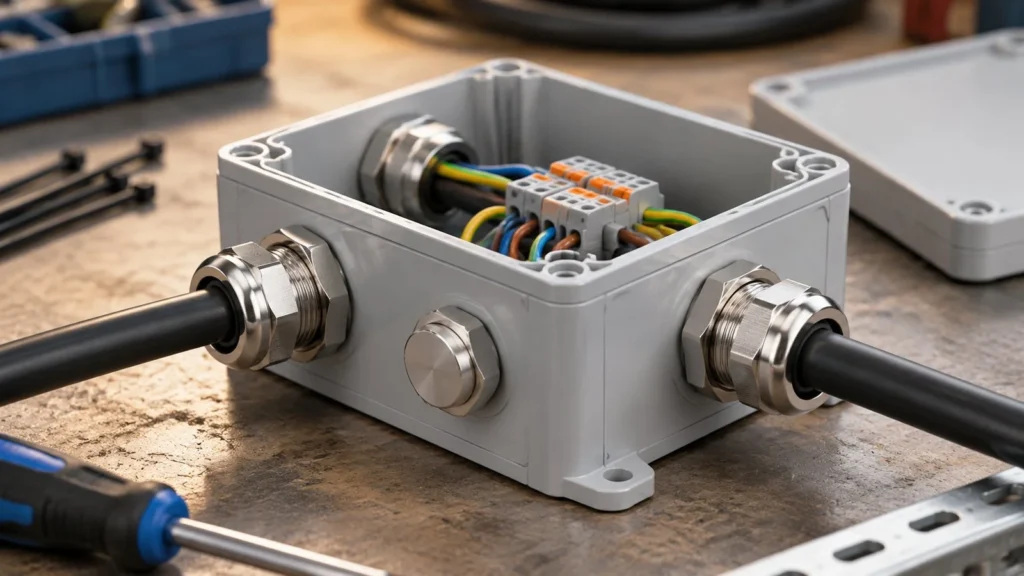
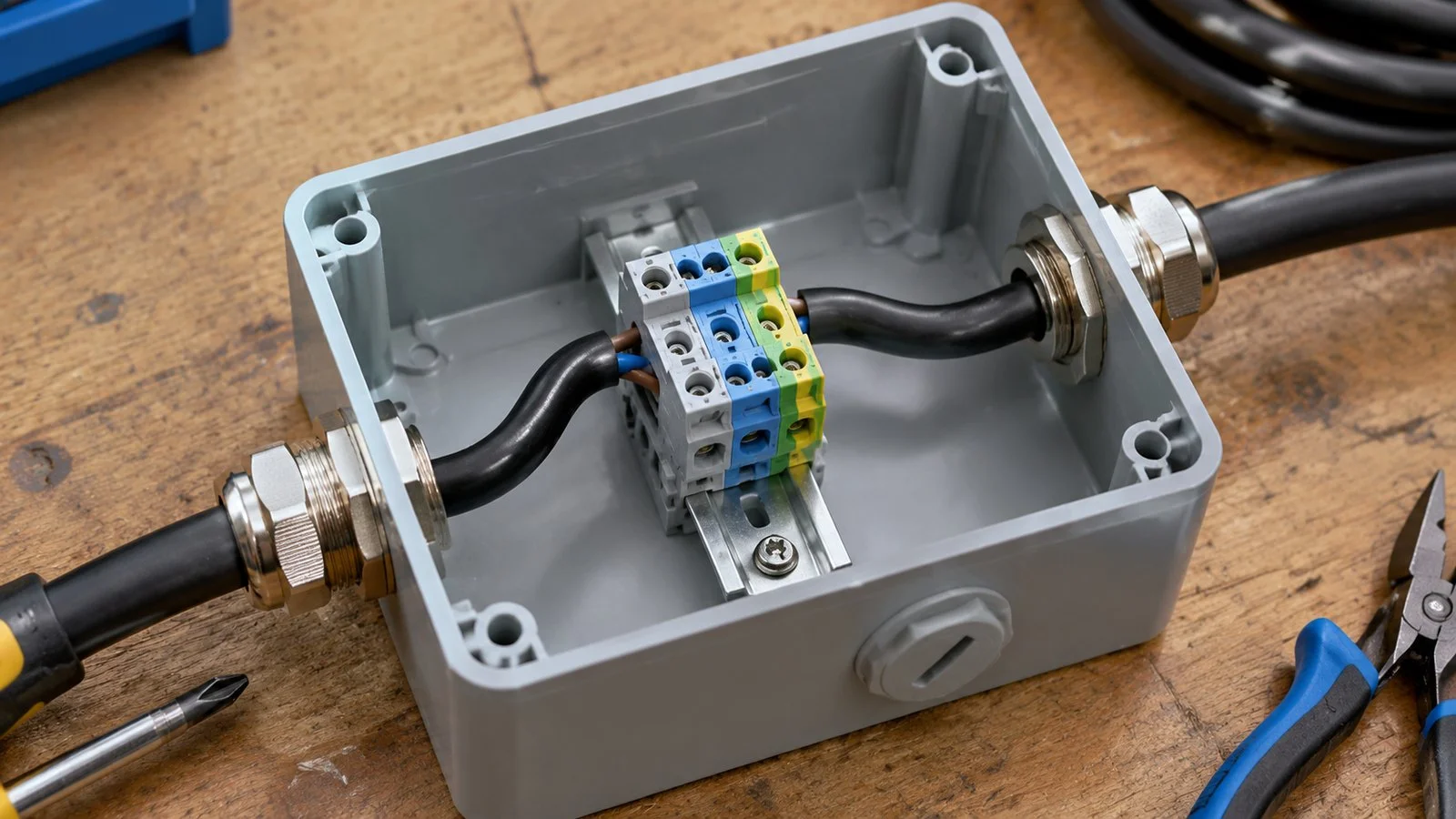
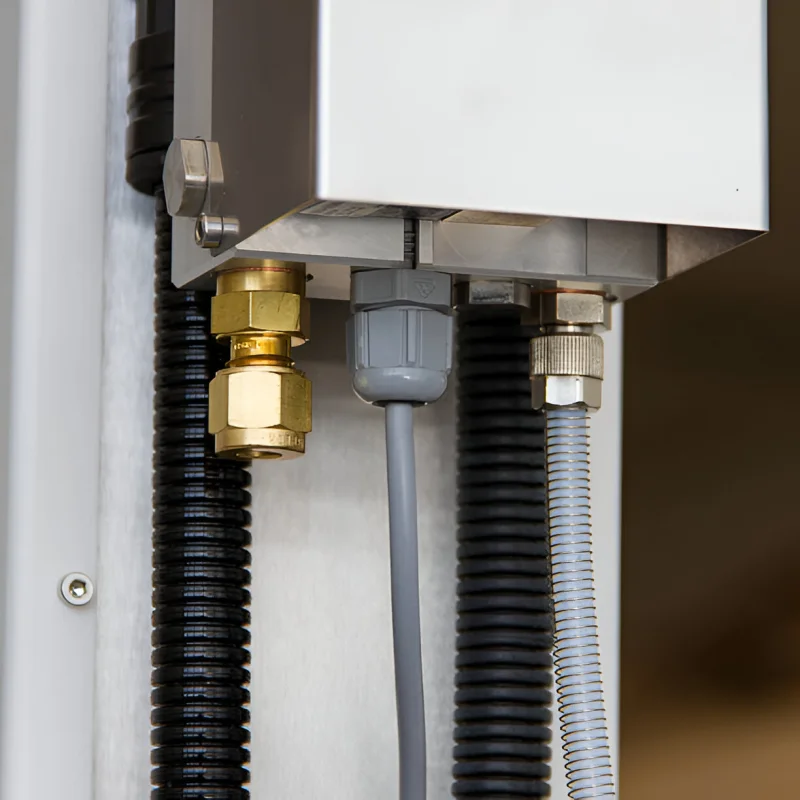
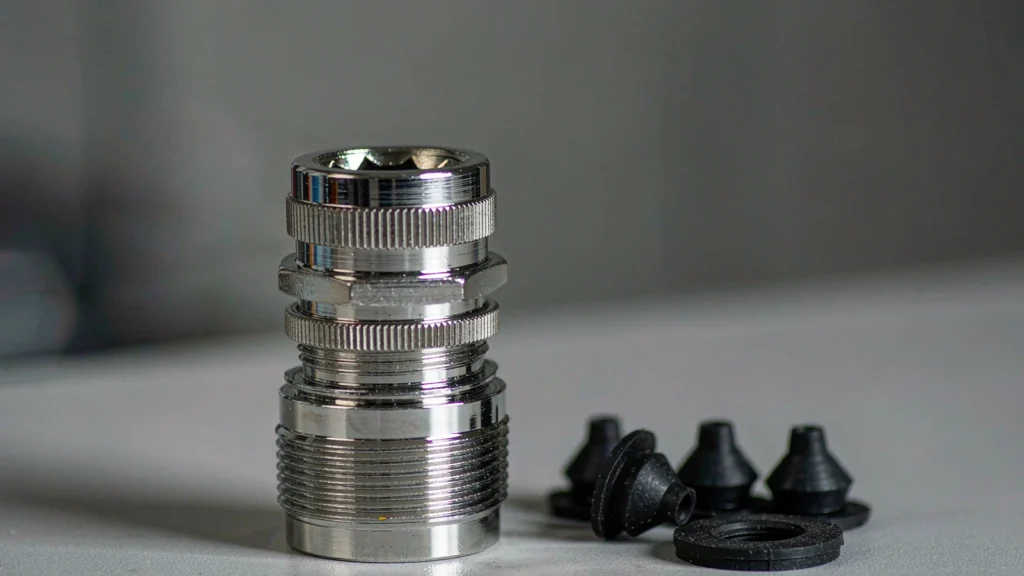
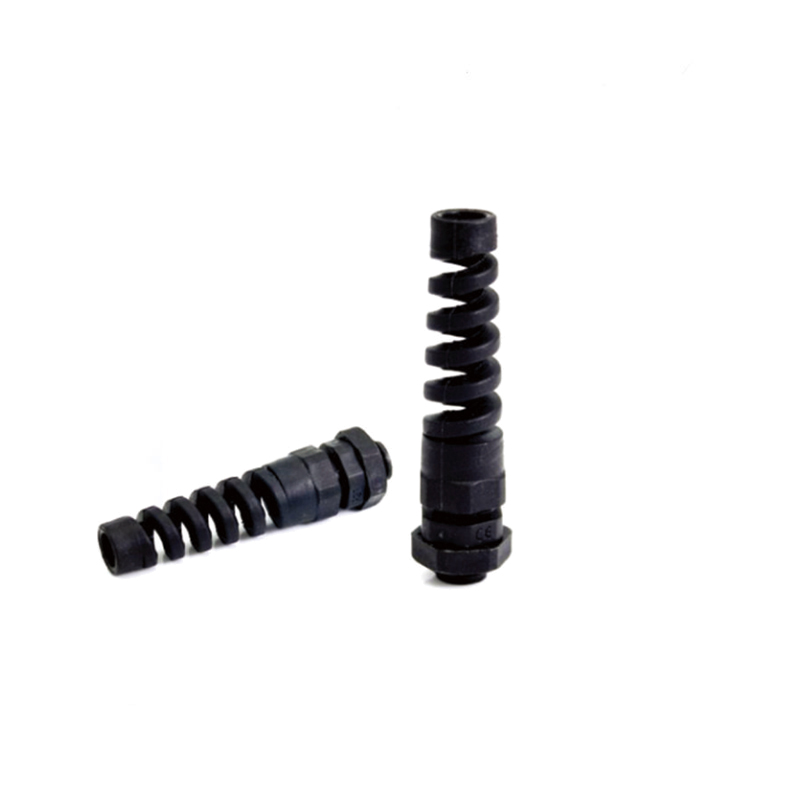
A junction box is where a cable run stops being a cable run and becomes a circuit. That sounds like a trivial distinction, but it changes what the cable gland has to do: the gland is no longer protecting the end of a cable, it is protecting one of several entries into a shared electrical node, and the mechanical load that used to be carried by the enclosure now has to be shared between them.
This guide treats the junction box as a node rather than a container: which gland configurations each type of box needs, who actually carries the cable weight, why two IP ratings do not add up, and why so many boxes leak without a single drop coming through the gland.
A Junction Box Is a Node, Not an Enclosure
The difference is in the cable count and the cable directions. An enclosure usually terminates a run: one cable in, a device inside, no continuation. A junction box joins runs, so it has two or more cables arriving from different directions, often at different sizes, and often with spare ways left for future circuits.
That has two consequences. The entry plan has to be designed as a plan, because the last cable added is the one that breaks a layout that was never generous enough. And the enclosure cannot be treated as a support, because every cable pulling in a different direction loads a different gland, and the sum of those loads is carried by a lid and a thin wall.
Which Kind of Box Are You Sealing
Box function
Typical entries
What governs the gland choice
Through or draw box
Two, opposite faces
Same size both ends; bend radius rather than seal
Branch or tee box
Three or more, different sizes
Each entry sized independently; spare way on the largest
Terminal or marshalling box
Many small entries
Density and identification, not cable size
Instrument or sensor box
One or two small, screened
Shield termination and small-range inserts
Ex junction box
Fixed, certified pattern
Only the entries the certificate lists, in that pattern
Buried or below-grade box
Two, on sealed ducts
Immersion rating and a drainage philosophy
Reading down that table, only one row is governed primarily by the seal. The rest are governed by geometry, density or certification, which is why buying a good gland is rarely the whole answer for a junction box.
Who Carries the Weight of the Cable
Inside a junction box the terminals are not a strain relief. They are sized to carry current and to be tightened once, and a cable hanging from a gland with no other support transfers its weight through the conductor into a terminal screw. The result is a joint that was correct at commissioning and is loose a year later, which then reads as a loose connection rather than a mechanical design error.
The load has to be stopped at the gland, which is what a proper clamping cage does, and the gland in turn has to be stopped by the box. On a light enclosure the third link is the weak one: the wall flexes, the locknut has nothing stiff to bear against, and the whole assembly moves as a unit. A stiffening plate or a gland plate resolves it, and it is much cheaper to add at build than to retrofit. The mechanics of the clamping end are covered in our guide to cable gland strain relief.
Inside the Box: Space, Bend Radius and Terminal Height
The gland projects inward, the cable has to bend immediately behind it, and the terminals sit at a fixed height on the rail. Those three facts interact, and the interaction is why a box that is adequate on paper can be impossible to wire. A thick power cable needs a real bend radius, and if the entry is opposite the terminal block with little depth behind it, the cable arrives at the terminal at an angle and the conductor is stressed for its whole service life.
Entry face, bend and terminal height have to be checked together; a box that is adequate on paper can still be impossible to wire.
The practical check is to lay the cable out at full size before the box is ordered: entry face, bend, terminal. If the bend does not fit, the answer is a deeper box, an offset entry, or a right-angle gland, in that order of preference. Trying to solve it by bending harder damages the conductor and, on screened cable, distorts the geometry that the shield termination depends on.
The IP Chain: Two Ratings Do Not Multiply
A box rated IP66 with glands rated IP68 does not produce an IP68 assembly. It produces a system whose weakest interface governs, and that interface is often the one nobody specified: the lid gasket, the knockout that was punched rather than drilled, or the gap between a gland body and a painted surface.
The correct way to read it is as a chain, where each link is a separate seal:
Link
What typically breaks it
How it is checked
Cable to insert
Cable at the top of the range; scored sheath
Measure the sheath; pull test by hand
Insert to body
Insert not seated; dome nut bottomed out
Dismantle one gland per batch
Body to wall
Knockout lip; paint on the sealing face
Look with the gland removed
Wall to lid
Compressed or painted gasket; missing screws
Water test on the assembled box
The assembly is as good as its worst link, and the gland only controls the first three. This is also why adding a higher-rated gland to a leaky box changes nothing, a pattern covered in our guide to why cable glands leak.
Knockouts, Wall Materials and the Flat Face You Need
A gland seals against a flat face. A knockout leaves a raised or torn lip, and a moulded plastic box often has a recessed ring around the entry that prevents the body from seating. Both are common on junction boxes and both are invisible once the gland is fitted.
Wall material changes the fixing method more than the seal: ABS and polycarbonate need a flat, unreinforced area and a locknut with a wide bearing face; cast aluminium tolerates more torque but strips suddenly; GRP and sheet steel deflect and need either a plate or a backing washer. The entry planning method in the combiner box entry guide applies to any multi-entry box, including the spacing needed for wrench access.
Condensation: The Leak That Never Came Through the Gland
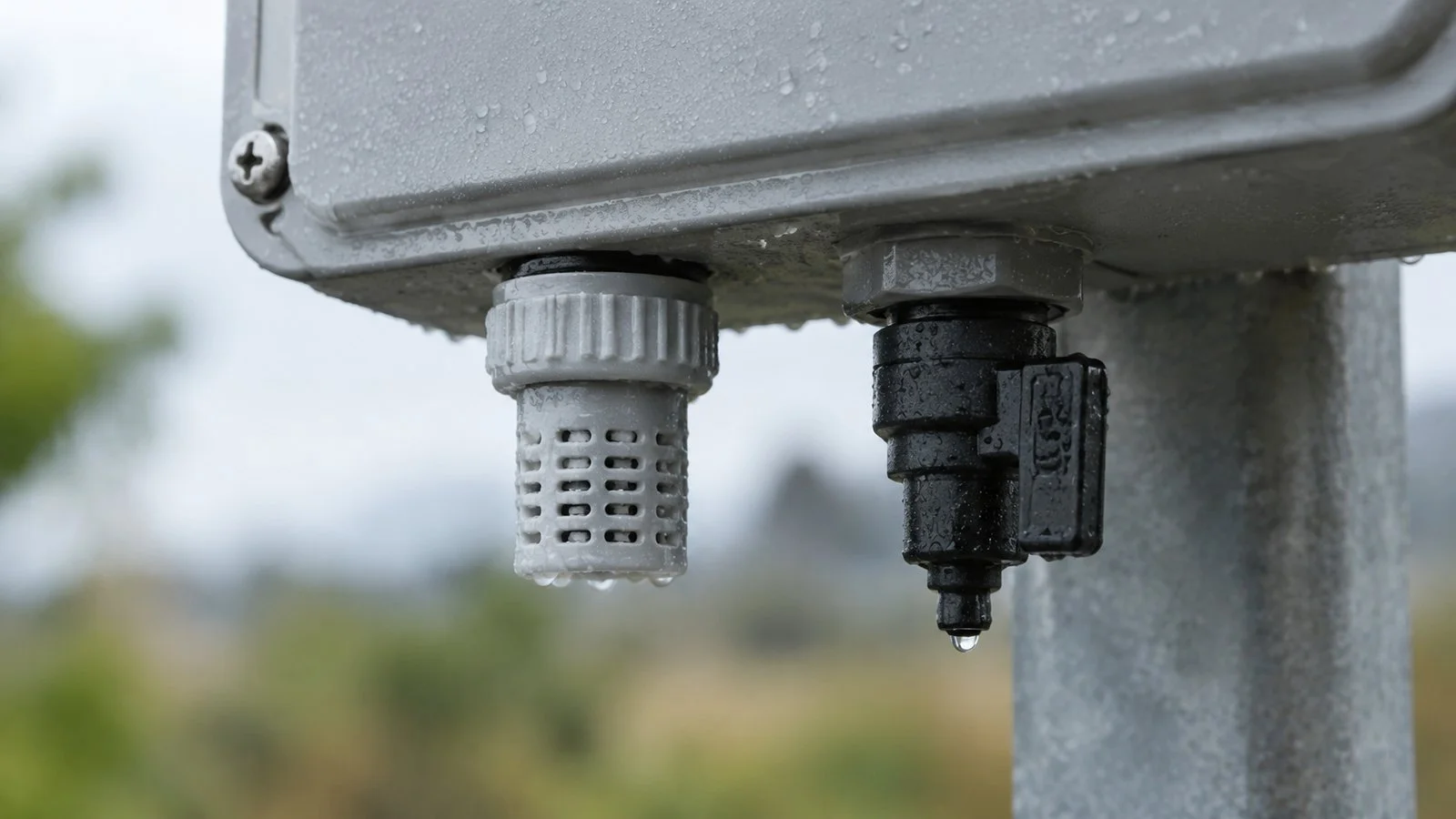
Most water found inside an outdoor junction box entered as vapour and left as liquid. Air inside the box expands when the sun heats it and is drawn out; when the box cools at night, moist air is drawn back in and condenses on the lid and on cool metal. The gland is working perfectly throughout.
A breather vent and a drain valve let a box equalise pressure without letting liquid water in.
This matters because the standard response, tightening the gland or adding sealant, makes the problem worse by reducing the box’s ability to equalise. The correct responses are a breather element that passes vapour but not liquid water, a drain valve at the lowest point, or a desiccant where the box is genuinely sealed. The installation precautions for waterproof glands include the orientation rules that keep rain out; condensation is the separate half of the same problem.
Spare Ways, Blanking Plugs and Marking
A junction box without a spare way is a box that will be modified on site. Every field-drilled entry is a hole without a flat face, without a deburr, and without a specified gland, so the cheapest reliability measure available on a junction box is one blanked spare entry per box at the factory.
Marking belongs in the same conversation. Where several cables enter a node, the panel schedule, the cable tag and the gland position have to agree, otherwise the next person to open the box traces cables by hand. A short engraved or printed tag on each entry costs less than one hour of tracing, and it survives the life of the installation in a way that a marker pen does not.
Writing the Entry Schedule
Field
What to write
Why
Entry ID
Position and face, matched to the drawing
Makes the box buildable and the service visit easier
Cable and OD
Tag plus measured sheath diameter
Sizing follows the sheath, not the conductor
Thread and size
Metric or PG, with pitch
A correct gland in the wrong thread still fails
Gland type
Standard, screened, or multi-cable
Determines the internal space needed
Load path
Where the cable is supported outside the box
Decides whether the gland carries weight
Spares
Number of blanked ways
Prevents field drilling later
Six lines per entry is enough to build the box once and service it for twenty years. The material and thread options referenced here are carried in the nylon y brass ranges, and the wall and fixing rules are set out in the enclosure entry guide.
Preguntas frecuentes
How many cable glands can one junction box take?
As many as the entry plan allows with tool access for each. Density, not seal performance, is normally the limiting factor, and the spacing needed for a spanner is usually wider than the spacing that looks tidy on a drawing.
Do I need IP68 glands on an IP66 junction box?
No. The assembly is governed by its weakest interface, so a higher-rated gland does not raise the box rating. Spend the difference on a proper lid gasket and flat entry faces instead.
Why is there water in a box with sealed glands?
Condensation, in most cases. Warm moist air enters as the box breathes, then condenses on the lid as it cools. A breather element or drain valve addresses it; tightening the glands does not.
Can a junction box be used as a cable support?
No. Terminals are not strain relief, and the box wall is not a structural anchor. Support the cable outside the box so the gland carries almost no weight, and stiffen the wall where the entries are dense.
What is the difference between a junction box and a terminal box?
Function rather than construction. A junction box joins cable runs and may contain joints; a terminal box brings conductors onto a terminal block for connection to a device. The entry requirements differ mainly in cable count and density.
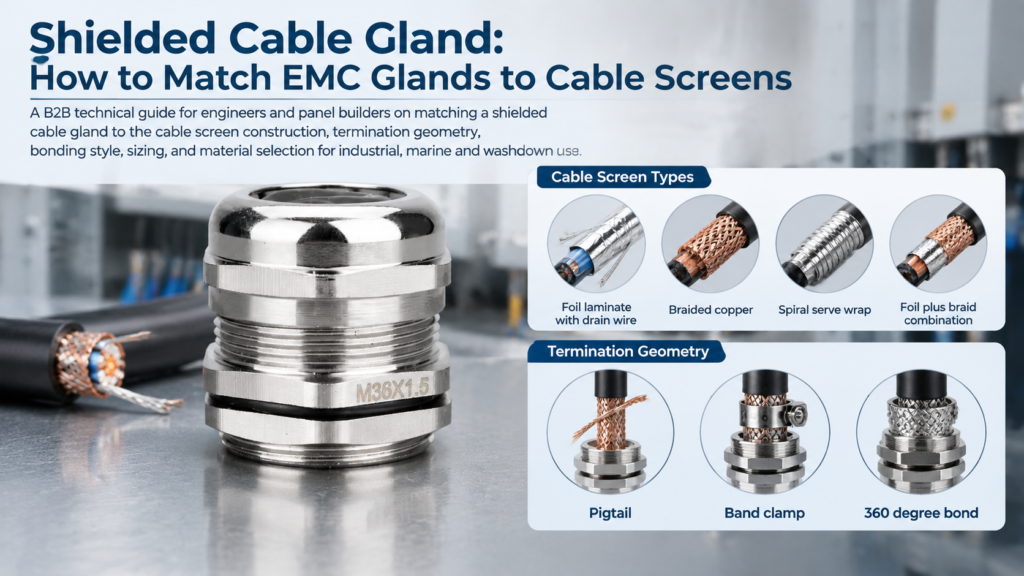
Match an EMC cable gland to the cable screen: foil, braid, spiral and combination constructions, termination geometry, bonding rules and sizing on jacket OD.
Descubra los prensaestopas partidos estancos con clasificación IP66 IP68 opciones de nylon latón acero inoxidable ideales para instalaciones de cables preterminados y reequipamiento.
A cable gland contains two elastomer seals, and they are not always the same compound. Here is how EPDM, NBR and silicone actually differ, where each one fails, and what to put in an enquiry.
Utilizamos cookies para mejorar su experiencia de navegación, publicar anuncios o contenidos personalizados y analizar nuestro tráfico. Al hacer clic en "Aceptar todo", aceptas el uso que hacemos de las cookies.