An NPT vs metric cable gland comparison usually turns into a table of thread angles and diameters, and that misses the point. The two systems seal in different places, and every practical difference follows from that.
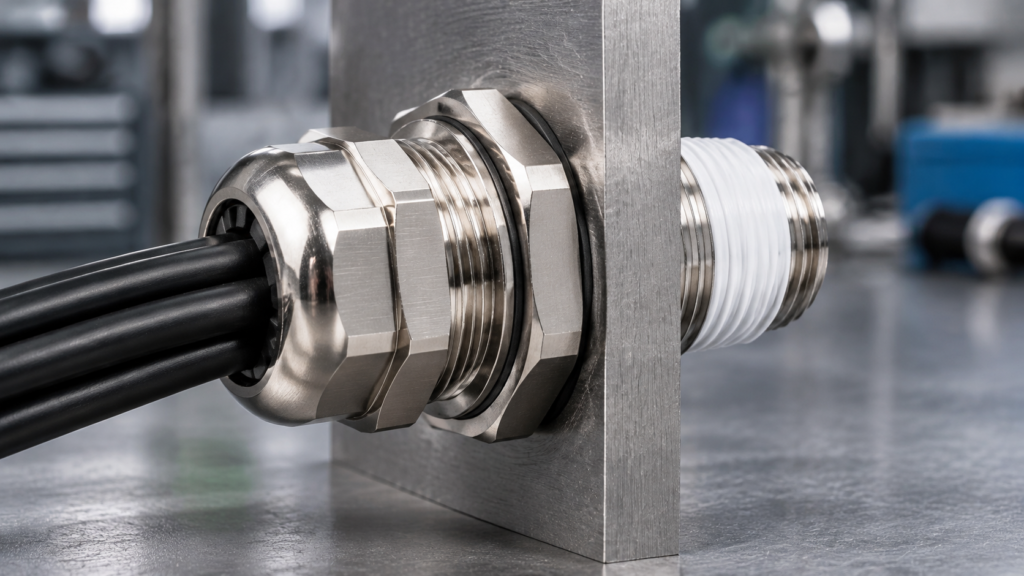
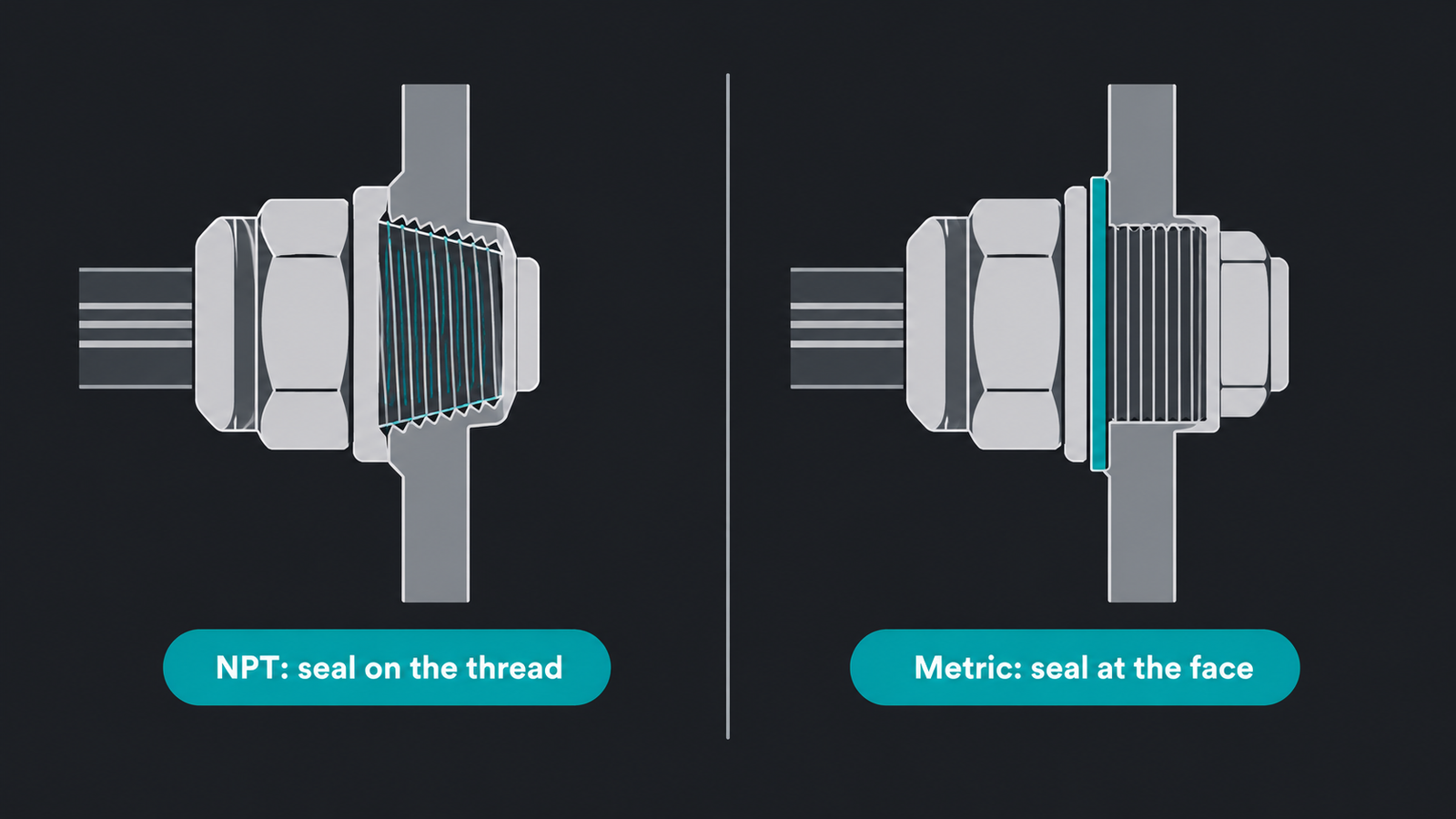
An NPT gland seals on the thread itself. The thread is tapered, the flanks crush against each other as it is tightened, and the metal-to-metal contact plus a thread sealant is what stops water. A metric gland does not seal on its thread at all: the thread is straight and merely holds the gland in place, while a washer or an O-ring compressed against the enclosure face does the sealing.
One seals on the thread, the other at the face.
Once that is clear, the rest is consequence: why the holes differ, why a locknut behaves differently, why sealant is essential in one system and unwanted in the other, and why the two cannot be substituted even when the diameters are close.
Tapered Against Parallel
Característica
NPT
Sistema métrico (M)
Profile
Tapered, 1 in 16 on diameter
Parallel, straight
Flank angle
60°
60°
Pitch
Expressed in threads per inch
1.5 mm across the gland range
Sealing element
The thread, with sealant
A washer or O-ring at the face
Size basis
Nominal pipe size, in inches
Thread diameter in millimetres
Región
North America
International, EN 50262 / IEC 62444
Because the flank angles are both 60°, the profiles look similar in a photograph, which is part of the problem. The difference is the taper: over a thread length of about fifteen millimetres, an NPT thread changes diameter by roughly a millimetre. That is small enough to look like a normal thread and large enough to change how the joint behaves.
Hole Preparation Is Not Interchangeable
A metric entry needs a clearance hole: an M20 gland needs 20.2 mm. An NPT entry has two valid forms, and neither is that hole.
The first is a tapped and reamed tapered hole in the enclosure wall, cut with an NPT tap to the correct depth. The second is a clearance hole with a locknut, used where the wall is thin and cannot carry a taper. The two are not interchangeable either, because the second relies on a straight section of thread that many NPT glands do not have.
The dimensional trap is the same one that catches PG buyers. A 1/2 inch NPT thread measures about 21.3 mm at its large end, so it will not enter a 20.2 mm M20 hole. Turned around, an M20 gland drops into a 1/2 inch NPT tapped hole and engages only the first few turns before the taper closes on it. Both are near misses that a fitter will attempt.
The Locknut Behaves Differently on a Taper
A locknut works by pulling the gland tight against the enclosure face. On a parallel thread it does that job well: the nut bears on a flat washer, the washer bears on the wall, and the load is spread over an area.
On a tapered thread, a locknut can only contact a narrow band of the taper, and tightening it pulls the gland out of the taper rather than into it. Engagement length falls as torque rises. Where an NPT entry uses a locknut, the gland should have a straight-threaded spigot behind the taper so the nut has something to bear on; a nut run directly onto the taper is a joint that will loosen.
Sealant: Where It Belongs and Where It Does Not
NPT joints need a thread sealant. PTFE tape or a PTFE paste fills the spiral leak path that remains between two metal flanks, and without it a tapered joint weeps even when it is tight.
Metric glands need none, and adding it does harm. Tape fragments contaminate the O-ring seat and can bridge the seal face; paste changes the friction that the tightening torque was calculated for, so the gland is either under-compressed or over-compressed against a washer that was not designed for it. On a metric gland the seal is the washer, and a washer only works if it is clean and flat against the enclosure.
One further caution applies to both: on a certified flameproof entry, the number of engaged threads is part of the certification and the enclosure manufacturer’s instruction governs whether any sealant is permitted. Where the entry is a flame path, a sealant that looked like good practice on a standard enclosure can be a non-compliance.
System
Sealant
Sealing element
What goes wrong
NPT, tapered
PTFE tape or paste required
The thread flanks
Dry assembly weeps along the spiral
Metric, parallel
Ninguno
Face washer or O-ring
Tape fragments bridge the seal face
PG, parallel
Ninguno
Face washer or O-ring
Same as metric
Flameproof entry, any thread
Per enclosure instruction
Specified thread engagement
Sealant that shortens engagement
North American Hazardous Locations Run on NPT
In North America, enclosures for classified locations are listed with specific entry threads, and for Class I equipment that entry is normally NPT. The listing covers the enclosure as tested, including how the cable enters it. Fitting a metric gland through an adapter does not reproduce the tested configuration unless the adapter is part of the listing.
This is why projects destined for the United States and Canada tend to specify NPT even when the same equipment is built on metric threads for Europe. It is not a preference for tapered threads; it is a consequence of which listing applies.
For the European and international route, the equivalent entry is metric, governed by the ATEX and IECEx framework rather than by the North American listing. The two routes are covered in more depth in the ATEX vs IECEx comparison y the hazardous area selection guide.
Adapters: What They Fix and What They Break
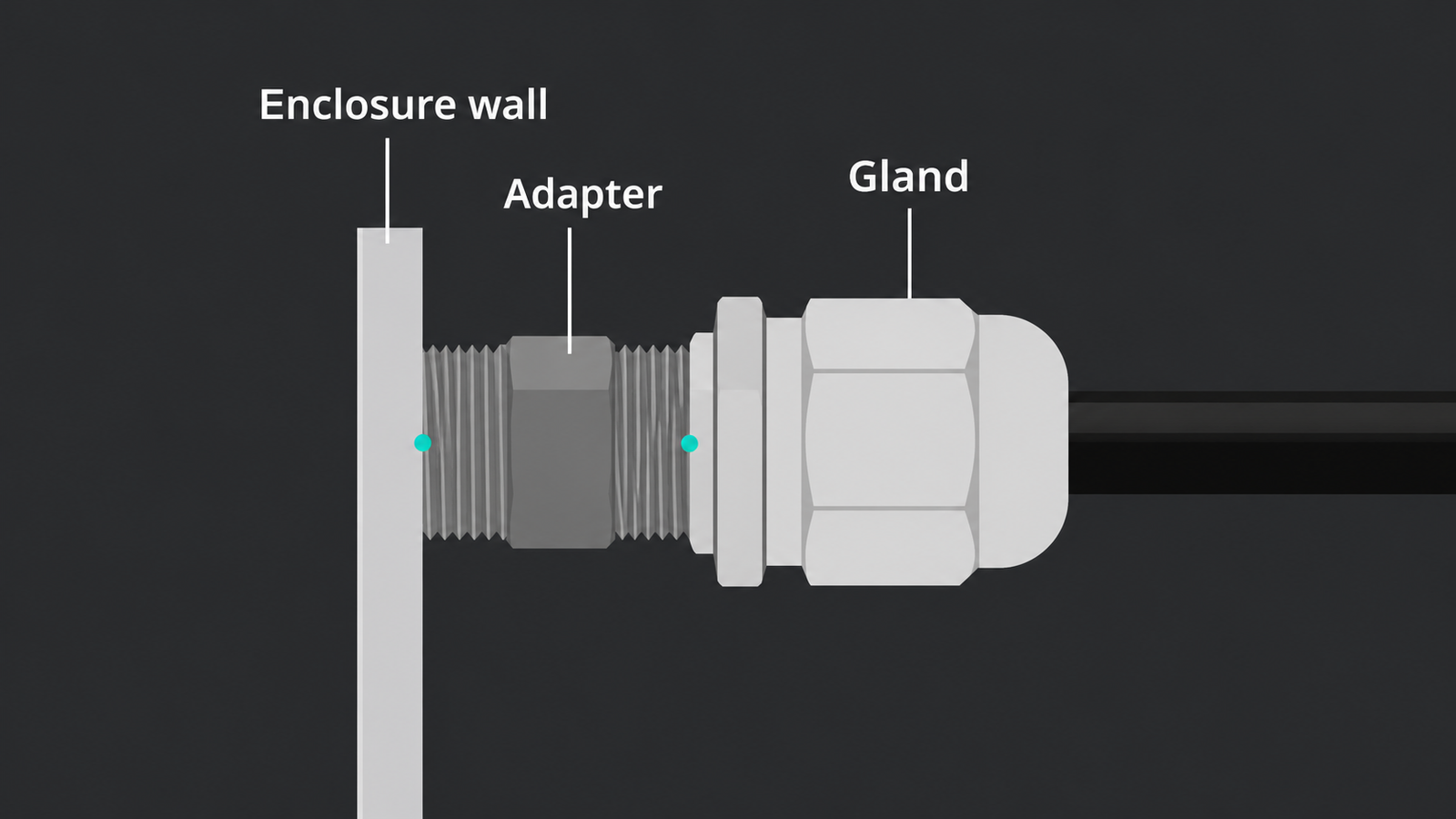
An adapter converts one thread form into another in a single machined part, and it is the correct answer where an existing entry cannot be changed. It is also a compromise that is worth costing properly.
Two joints where the design had one.
Three things change. A second threaded joint is introduced, and each joint is a potential leak path with its own sealing method. Axial length increases, which matters inside a shallow enclosure or where the cable must bend immediately. And the earth path now runs through an additional component, which is acceptable for a metal adapter fully engaged but not for a plated or plastic one.
In a hazardous location there is a fourth consequence: the adapter may take the entry outside the enclosure’s listing. That is a compliance question rather than a mechanical one, and it is decided before the part is ordered, not after.
Reusability and Maintenance
Tapered joints are not designed for repeated assembly. Each tightening deforms the crests slightly and each loosening removes some of that interference; after a few cycles the thread no longer reaches the same engagement at the same torque, and more sealant is used to compensate for a fit that has already been lost.
This matters for equipment that is opened regularly. A junction box entered through an NPT gland that has been re-made five times is a different joint from the one that was tested, and it will not be obvious from the outside. Where regular access is expected, the practical answer is a straight-threaded entry with a proper sealing washer, in whichever system the enclosure uses, so that the seal is a replaceable part rather than a property of the thread.
Conversion and Specification Table
Requirement
Correct specification
Common mistake
Enclosure tapped NPT, North America
NPT gland, sealant, correct engagement
Metric gland plus adapter in a classified area
Enclosure with clearance hole, thin wall
Straight thread, washer, locknut
Running a locknut onto a taper
Metric enclosure, European project
M-size gland, O-ring or washer, no tape
PTFE tape on the thread
Existing NPT entry, new metric gland
Documented adapter, metal, fully engaged
Forcing a near-size thread
Frequent access
Straight thread with replaceable seal
Re-making a tapered joint repeatedly
Tipo
Specification
Typical application
Indicative FOB price
Brass gland, metric
M12–M63, 1.5 mm pitch, IP68
International projects, general industry
US$0.08–1.20
Brass gland, PG
PG7–PG48, IP68
Legacy European equipment
US$0.08–1.20
Stainless gland, metric or PG
PG9–PG63, IP68, −40 to +200 °C
Coastal, marine, chemical
Quoted per size
Indicative FOB Ningbo / Shanghai, 1,000 pcs per size; stainless 300 pcs per size.
Thread form is fixed at the enquiry stage, not at despatch, so state it on the drawing. The thread types guide covers all four systems, the PG vs metric comparison covers the European equivalent of this problem, and the brass y acero inoxidable ranges list sizes against thread system.
PREGUNTAS FRECUENTES
Is 1/2 inch NPT the same as M20?
No. The NPT thread measures about 21.3 mm at its large end and is tapered, so it will not enter a 20.2 mm M20 hole. The sizes are close in cable range, not in thread.
Can I use PTFE tape on a metric cable gland?
No. The metric gland seals on a face washer or O-ring, and tape fragments contaminate the seat. Tape belongs on tapered threads, where the seal is the thread itself.
Why does my NPT gland keep loosening?
Usually a locknut bearing on the taper, or engagement lost through repeated assembly. A nut needs a straight-threaded spigot to bear on; on a bare taper it pulls the gland out instead of in.
Do I need an adapter for a metric gland in an NPT enclosure?
Mechanically yes. In a classified location, check the enclosure listing first, because the adapter may take the entry outside the configuration that was tested.
Which thread should a new export machine use?
Metric for Europe and most of the world, NPT for North America, PG only where legacy equipment requires it. Decide at design stage; changing later means adapters or re-tapping.
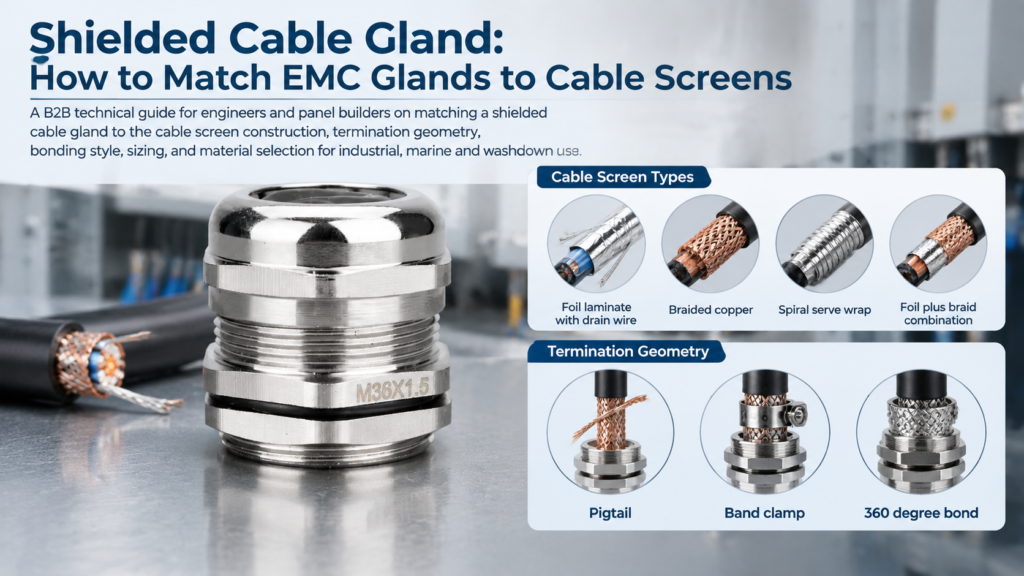
Match an EMC cable gland to the cable screen: foil, braid, spiral and combination constructions, termination geometry, bonding rules and sizing on jacket OD.
Explore los duraderos conectores prensaestopas impermeables con clasificación IP67 e IP68 de nailon, latón y acero inoxidable para una protección segura de los cables y alivio de tensiones.
Single compression uses one elastomer seal to both grip and seal the cable; double compression splits those duties across two seals. Here is where the difference decides an installation.
Utilizamos cookies para mejorar su experiencia de navegación, publicar anuncios o contenidos personalizados y analizar nuestro tráfico. Al hacer clic en "Aceptar todo", aceptas el uso que hacemos de las cookies.